Earth Day Comp: And The Winners Are…

Drum roll please …

Riot Grrill and Alexander West!

Congratulations!

If you will get in touch via

contact@gripandgo.co.uk

and leave your details plus the colours you would like in each of the 350ml, 500ml and 1 litre bottles as well as a travel mug, they will send off your prize asap.

But wait…

Grip and Go don’t want anyone to lose out, so they have generously given you all a

25% Off Discount Code:

Use STILLWINNERS at the checkout

Please Like and Follow @GripandGoUk on Twitter Or on Facebook

This code must be used by midnight on Friday, 6th May, 2016

(sorry  UK residents only)

Visit the Grip and Go website and look at their range of stylish glass bottles and double-insulated travel mugs!

Treat yourself or buy someone a gift. Great for storing juices, nut milks and water. Much better for you and the environment than single-use plastic water bottles.

Thank you all for taking part and to Grip and Go for a great prize!

Copyright: Chris McGowan

Water: They Can’t Get Enough, But We Can Help!

Recently, while I was thinking of writing a post on hydration, there was a sudden deluge (pardon the pun) of articles and tweets on the subject. Everywhere I looked, someone was urging that I drink more water. I thought to myself, If I drink any more, I’ll float away! But as I sipped my regular morning hot water and lemon and then had a shower and washed my hair, cleaned my teeth and flushed the loo, I started musing on how much we take our clean water supply for granted and how much we complain about the incessant rain.

Have you ever experienced a drought, even temporarily? I have.

Have you ever had to use a stand pipe down the street in one of the hottest summers on record and queue up for a restricted amount of water, carry heavy containers home, ration it out, use the same washing water for all the family, then use it to flush the toilet that has had to be used several times without? I have.

Have you had to do this with a toddler still in nappies – cloth ones that needed sterilising? Or with a baby using feeding bottles? I have. Have you ever been heavily pregnant during a hot summer and had the water go off because of a burst pipe, making it necessary to walk a couple of streets away to the nearest public toilet for a day and a night? I have. During that hottest summer, I was also coping with a slipped disc.

It was indescribably difficult.

Yet our difficulties and inconveniences (pun intended) were nothing compared to those endured week in week out, by millions of families in developing countries where mainly wives, mothers, sisters and daughters spend hours every day walking miles to collect water that is often contaminated with bacteria, parasites and disease, for example E. Coli, Cholera and Hepatitis A.

Between 600 and 700 million people have no clean drinking water, while over 2 billion do not have access to toilet facilities.

image

Image from Jerry Bottles

While I was contemplating this, tweets began appearing on my timeline about Matt Damon and Gary White’s charity Water.org and the British organisation, Water Aid UK. Then purely by chance, someone called @jerrybottles liked one of my tweets. I looked them up. While I did so, two other companies showed up: Conscious Step and Three Avocados.

These companies have one thing in common: they are non-profit businesses that sell unique products to raise money for clean water projects around the world.

100% of their net profits go to these projects.

This all seemed serendipitous and I decided to promote their organisations via my blog. If one person buys one item after reading this, then I will feel like I’ve done something worthwhile.

These companies sell very different quality products and I want to point out that I haven’t been given any to promote, nor have I purchased or used any of them. Purely and simply, I looked at their web sites and products, read their missions and wanted to help in this small way.

First up is Jerry Bottles

image

Leicester-based businessman, Harun Master, set up his charity in 2011 to help fund and co-ordinate clean water schemes in India and Africa. Their stainless steel bottles – named after the large jerry cans used by women to collect their water – are stylish, dishwasher safe and sustainably produced. Along with Tobias Gould and Taj Bharma, he built a company whose mission is to educate about pollution caused by plastic bottles, encourage the use of refillable steel bottles and use the profits to provide safe, clean water – starting in Tanzania. As a bonus, the co-ordinates of each project will be printed on the base of the bottles so you can see where the proceeds from your purchase have been put to use. They keep costs and staffing low to maximise the funds available for the schemes.

image

They are also working with local shops and businesses to build a scheme whereby you can refill your Jerry water bottle for free when out and about. They aim to add to their range by working with designers to create additional quality bottles and accessories. The web site is informing and fun, as are their tweets!

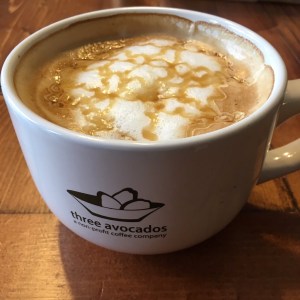
Three Avocados is the fascinating name of a coffee company in St Louis, Missouri, founded by Joe Koenig in 2010 after a trip to Uganda. The poverty surrounding him inspired him to set up a company which sells 100% Arabica coffee – produced by small farmers in Uganda and Nicaragua for fair prices – and donates all its net profits to clean water projects worldwide. One of their partners is a women’s co-op which uses the money earned from growing coffee to send their children to school.
image

In Uganda alone, without clean water, 63 children die every day. Since the company started, over 20,000 people have benefited.

image

Women and girls are usually the ones who walk miles every day to collect large jerry cans of contaminated water. They are unable to work or attend school. They are at risk of assault. Providing clean water allows them to gain an education and employment as well supporting a healthier community.

image

Oh, and why is a coffee company called Three Avocados? Well, visit the web site and read their story – just have some tissues handy when you do.

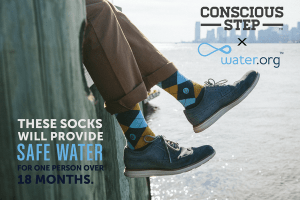
Conscious Step is the brainchild of 3 like-minded men: Hassan Ahmad, Adam Long and Prashant Mehta, left their respective careers at the World Health Organisation, Engineers Without Borders and in Microfinance, and came up with the quirky idea of selling uniquely designed and manufactured Socks for Causes,  to combat Hunger and HIV/Aids, promote Education and provide Clean Water.
image

In partnership with Water.org net profits from these blue Argyle socks provide clean water for one person for 18 months!

image

(Images from Conscious Step)

The socks are certified Fair Trade and are made from organic cotton using non-toxic dyes.

I asked in my previous post ‘ What Colour’s Your Wee?! Water: Part 1 – Are You Getting Enough? Well, for some, this question is moot. They can’t get enough. What they can get is more often than not a long trek away and unsafe to drink.

You can help change that.

Copyright: Chris McGowan
“a life to which I feel myself a stranger.” -Swiss Long Rider Ella Maillart

A welcome update from Marc on his Long Saunter South through Central and South America, where he raised money and awareness for children in orphanages and special needs schools, and news of Red, his faithful steed!

vaquero's avatarThe Long Saunter South

Several months ago I returned home, to my loving family whom have been there with me every step of this journey. Still, months later it does not feel real. Taking in what happened and feeling out of place in my home town. It can be hard to process the changes that occur, not only within but the advances in the “civilised world” wifi, fingerprint recognition, smart phones, faster connections and no, I am not on snapchat. A lot can change in four years. Life seemed a lot more simple out on the road ….. however, I am not missing the chicken soup.

Lotus-Root-Rice-Bean-and-Chicken-Feet-Soup

Red, my horse, I am reliably informed is doing well, I wake every morning thinking of him, sometimes still disorientated enough that I jump up shouting his name, looking for him. He is safe and healthy with the wonderful family I got to spend time with in Ecuador…

View original post 410 more words

Garden Glove Love

This is such a simple but potentially life-changing scheme initiated by pioneering the simple life: collect discarded/lost gardening gloves, pair them up and send to Nepal to help child rag pickers protect themselves from glass, excrement, chemicals, and infections. We should all get behind this: we’ll be searching the shed, the cupboard under the utility room sink and collecting from our neighbours and family – it may take some time, we are spread over the country, but eventually we’ll parcel them up and send them off. Great idea!

Update: 3 days later, we have the beginnings of a collection!

image

Liesl Clark's avatarPioneering The Simple Life

Roadside Garden Glove. Photo © Finn Clark

It all started on a bike ride. We kept seeing garden gloves along the side of the road. In fact, we had seen the gloves lying there for weeks and finally decided to pick them up. One by one, over the course of about 2 weeks, we had managed to collect 20 pairs!

I Have Good Garden Glove Karma. Photo © Liesl Clark

We’re an island of avid gardeners, farmers, and a world-famous garden tour called “Bainbridge in Bloom.” Twelve months of gardening weather here on Puget Sound has afforded us 4 seasons of dirt digging. The problem is that the gardeners’ (or perhaps it’s the hired landscapers’) gloves too often end up along the sides of the roads, having fallen from the backs of landscaper’s trucks, farmers’ tractors, or islander’s cars. Being a food-grower myself, I couldn’t just let those gloves rot in the ditches.

Garden Gloves Rain or Shine. Photo © Finn Clark

My children and I have been collecting them: pulling to the side…

View original post 966 more words

How Underground Networks Can Outperform Aid Orgs

We all sit at home watching or reading the news about disasters such as last year’s earthquake in Nepal and, other than donating money to relief organisations, we think there’s nothing else to be done and move on to the next news item. With supplies being tied up in red tape, stolen or resold at exorbitant prices and eventually running out, these individuals looked at the bigger picture and via social media organised an underground relief network that really did make a difference to many villagers who might otherwise have perished. With so many disasters of one kind or another in the world, it can often be overwhelming if not paralysing. This article shows how it can be done and will hopefully stir others into action. Please read and repost.

Liesl Clark's avatarPioneering The Simple Life

It was less than a week after the April 25th, 2015 magnitude 7.8 earthquake hit Nepal that we came to realize little-to-no relief had reached villages beyond Kathmandu. Roads were dangerous; But even worse, as time progressed, supplies for temporary shelter for the over 2 million now homeless had dried up. Tents and tarps were sold out in Kathmandu. Foreign governments and aid organizations were being shut down at the airport, their incoming supplies requisitioned by Nepal customs, and much-needed food, tents, tarps, blankets, and medical supplies were sitting on the runway, tied up in a confounding wad of red tape. 

7_Damaged house.anup © Anup Gurung

Our friends in Nepal were frantic, texting us asking for any means to get materials over to the remote villages. Aid organizations trucking supplies to villages were stopped along the roads by desperate, angry, and hungry people who lived right along the road who also had seen no relief. Supplies were…

View original post 1,222 more words

Passing It Forward

Many years ago, a good friend was visiting from overseas with her young daughters. Of course, despite only being September, the weather was wet, grey and chilly. She observed me struggling to dry the family’s clothes on a plastic airer in front of a heating vent on the wall of our tiny kitchen. There was nowhere else to dry them and we had problems with condensation and damp.

My friend insisted on buying us a drier. It made life so much easier and I never forgot her generosity.

Several years later, when our circumstances were much improved, I became aware that another friend, a lone parent with a young child, was in difficulties: her ancient fridge freezer had finally given up the ghost and she had no money to replace it.

I gladly offered to buy her a new one.

I was, as the Americans phrase it, ‘passing it forward’ and it felt good to repay the original act of kindness in this way. I knew the second friend would do the same when she was able.

These gifts were expensive but much-appreciated, they enhanced the lives of the recipients for a very long time.

But it doesn’t have to cost a lot of money – or even any money – to Pass It Forward.

Next time you do a clear-out of your wardrobe, your loft, your children’s toys, your shed or garage, think carefully about who might benefit from your passing it on. The local charity shops will welcome clean, useable clothing, toys, kitchenware and so on, many even take small working electrical goods. Playgroups and nurseries are sometimes short of good quality toys, books and play equipment. Women’s Refuges are often crying out for clothing and baby equipment.

We sometimes send books and refurbished bikes to our local Combat Stress centre.

Occasionally, we put an item at our gate with a note saying ‘free if you take it away’ or a serviced secondhand bike with a minimal price on which is donated to our local hospice.

Remember all those times when you were in need and someone helped you out, then pass it forward when your circumstances allow it. It can even just be the giving of your time.

I promise you, the recipient won’t be the only one who benefits.

Copyright: Chris McGowan

Compassion is Good for Our Health

In the light of the terrible mass shooting in Orlando, I decided to reblog the post on compassion and well-being which I adapted after the attacks in Paris at the end of last year. I am not American or gay and I don’t know enough of the facts or the context to feel qualified to write a separate post, other than as a human being horrified by such actions and the ease with which people can obtain weapons and carry out these targeted, violent acts against people just trying to live their authentic lives. My thoughts are the same as after Paris and they are with all those affected by this and other such tragedies. (And today, June 16th,  one of our own has had her life cut short and her family has lost a precious woman who worked to improve the lot of others).

When one hurts, we all hurt.

*

Some of the most poignant and remarkable acts of compassion are often performed by those to whom Fate has dealt some very unlucky cards: children with terminal cancer raising money and awareness from their hospital beds, severely injured veterans taking part in sporting events to raise funds to provide equipment and support for their colleagues, the bereaved parents of a teenage addict providing education and support for young people. It is well-documented that those with the least resources are often the most generous.

Doing something positive to help others can often provide a way out of our own dark place, it can help raise our spirits, lift our heads and enable us to see a way forward.

 Expressing compassion and empathy is not only beneficial for the recipient, but for the giver too: being kind produces oxytocin which reduces anxiety and depression, strengthens the immune system and helps control the effects of stress. It also stimulates the vegas nerve which controls inflammation throughout the body. Inflammation is believed to be a major factor in developing chronic diseases and ageing.

When we help one another, we all benefit.

At this particular time of year, there are many people for whom compassion would be the best gift of all: newly-arrived refugee families being resettled into the community; people rendered homeless through losing a job, their relationship, their home; young people on the street because they are not welcome in their family home; those subject to physical or emotional abuse; elderly or disabled people left isolated, with little support.

Yet recent newspaper headlines, government polemics and negative online comments concerning an ‘influx’ of refugees, fear of potential terrorists based on little else but a person’s cultural or religious background and so on, might lead an alien visitor to Earth to conclude that compassion is currently in short supply. When our circumstances change for the worse, when money is in short supply or illness strikes, when we fear for the safety of our loved ones, it is understandable that our concerns are for our own well-being and that of our families. Life can seem overwhelmingly difficult. There can be little room for considering the lot of others.

But consider recent events in Paris. At an international football match, once fierce national rivals -both teams and fans of all racial and cultural backgrounds – came together, arms around each other and sang La Marseillaise, in a stirring and defiant display of unity reminiscent of the famous scene in the film Casablanca, when French citizens drowned out drunken Nazi singing with a powerful and emotional rendition of their own national anthem.

image

Ultimately, we are more alike than we are different.

I would like to express my depest condolences to all those affected by these recent events, either directly or indirectly.

I believe that compassion is innate in all of us: when one of us hurts, we all hurt.

Coming together, pooling resources, sharing our time, experience and compassion is how we pull through.

In The Art of Happiness,* HH Dalai Lama says that the purpose of life is the pursuit of happiness and happiness is ultimately achieved through compassion for others. It is a principle by which I have tried to live my life.

Compassion is good for our collective health.

image

*The Art of Happiness: A Handbook for Living by HH The Dalai Lama and Howard C. Cutler, Easton Press, 1998

Copyright: Chris McGowan