Warming Sweet Potato & Ginger Soup

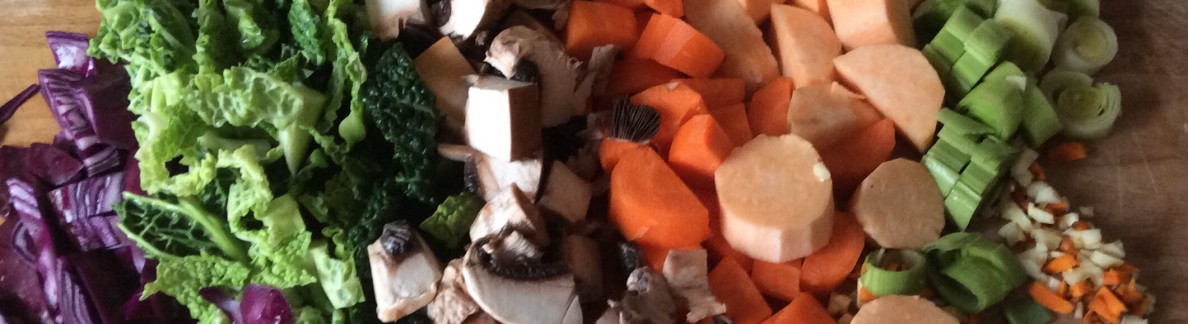
img_2883This is a favourite in our house, it is so simple and quick to make and makes a very welcome lunch or dinner on a cold winter’s day. It takes less than an hour to make and you can make it as thick or thin as you like and spicy or not according to your tastes. We prefer to blend it with a stick blender to thicken it up, but leave it a little coarse. We steamed a little broccoli for garnish and extra nutrients.

Sweet potatoes and carrots are a good source of beta-carotene, for healthy eyesight, while sweet potatoes also contain Vitamin D, B vitamins, iron and magnesium – necessary for relaxation of mind and muscles; celery contains potassium, B vitamins and, like carrots, is a good source of Vitamin K, necessary for bone health; ginger is anti-inflammatory, anti-fungal and anti-bacterial. Broccoli is a good plant source of calcium, B vitamins and protein. The yeast extract contains protein and B vitamins, including B6 and B12, important for vegans. So now you’re good to go!

All measurements are approximate and all ingredients are vegan, gluten-free and organic where possible. Hence, we scrub the veggies and leave the skin on for more nutrients and more flavour.

img_2880

Ingredients

1 Tsp Raw Virgin Coconut Oil

3-4 medium Sweet Potatoes, chopped

3-4 Medium Carrots, chopped

1/2 a Stick of Celery, chopped

1-3 thin slices of Ginger Root, depending how thick the root is and how spicy you want the soup, very finely chopped

1 Tsp Yeast Extract, we use Natex as is low salt and has a slight herbal taste.

1 Low Salt Vegetable Stock Cube

dissolved in about

500 mls of hot water (enough to cover the veggies)

Black Pepper

A few small florets of Broccoli to steam for garnish

Method

Melt the oil. When hot but not smoking, add the ginger and stirfry for a few seconds before adding all the other veggies except the broccoli.

Add some Black Pepper.

(Black Pepper aids absorption of nutrients as well as adding flavour).

Stirfry for a minute or so, mixing them up as you do, then turn down the heat, place a lid on the pan and allow to sweat for about 15 minutes, stirring occasionally.

Add the stock and Natex, turn the heat up a little, but try not to allow it to boil. Replace the lid and reduce the heat to a gentle simmer.

Leave to cook for about 40 minutes, until the veggies are done but not falling apart.

Steam the broccoli.

Turn off the heat, remove the pan and blend with a stick blender.

For a more substantial meal, you could place some cooked orange lentils or organic brown basmati rice in the bottom of the bowl before ladling the soup over the top. 

Top with the broccoli or, alternatively, some bean sprouts.

img_2662

Serve with crusty bread.

PS. Look out for Zesty Orange Squash Soup, coming soon!

Copyright: Chris McGowan

500 Up: It’s Giveaway Time!

Yesterday, I received a lovely surprise in the form of a notification from WordPress that I now have 500 followers! I only began blogging just over a year ago, not having much of a clue technically, but having completed the Blogging 101 course I had gained a little more know-how and a few blogging friends, many of whom are still with me and have provided much-needed support.

My (at the time) newly-retired husband is very grateful to you all for keeping me occupied and out of mischief!

To say thank you, we are having a small giveaway. 

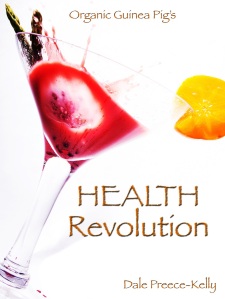
imageMy friend, Dale Preece-Kelly, aka Organic Guinea Pig, published his first book ‘Health Revolution’ almost 2 years ago. I have a spare paperback copy to give away. You can read a fuller review of the book here but briefly, Dale lost everything, his marriage, his home, his job and almost his life following a motorbike accident. His lifestyle didn’t help: he smoked, drank was overweight and had a heart attack.

He managed to turn his life around through healthy eating, juicing, exercise and a positive attitude.

Dale tells his story in a chatty, light-hearted style, providing amusing anecdotes, recipes and advice in a non-dogmatic manner.

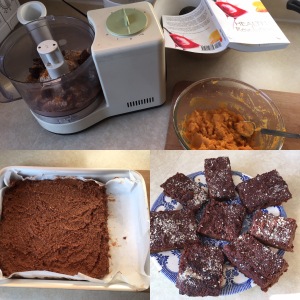
We had a visit from our smallest grandchildren at the weekend and we made Dale’s Sweet Potato Chocolate Orange Brownies, the recipe is in the review above and in the book.

0edb3010-994f-48c6-b6f2-b1457f114537

If you would like a chance to win this book, simply leave a comment on this post saying you would like your name to go into the hat. You don’t need to do anything else.

  1. The competition is open to all my Blog Followers. My husband will pick a name at random.

2. The competition runs from publication of this post until midnight GMT Saturday, 28th January, 2017.

Dale is a successful author, nutritional therapist, Life Coach and also runs a renowned and well-respected animal assisted therapy business, focusing on mental health issues.

Health Revolution’ and Dale’s new book ‘Unleashing The Healing Power of Animals ‘ are available on Amazon.

Copyright: Chris McGowan

Environmental Benefits of Adopting a Vegan/Vegetarian Diet

img_6532

Vegans are often held to a higher standard when it comes to dietary ethics, be it the environmental impacts of their food choices, animal welfare or health benefits. We all have our own line in the sand, we do what we can given our circumstances and our resources.

Here are some of the ways a vegan/vegetarian lifestyle can be beneficial not just to our own health as individuals or in terms of animal husbandry but for our environment and the world’s populations too.

First, water.

img_6549(Graphic from Vegan Community)

This is quite a startling graphic given the water shortages in some parts of the world. And it doesn’t end there.

Chemical run-offs from farming and processing livestock also contaminate water supplies.

Climate:

Intensive livestock farming and its support infrastructure are a major contributor in the production of greenhouse gases, both from the production of methane but also from transportation, and at current rates this could rise by 50% by 2050. According to a Guardian Environment article which quotes a study from Oxford Martin School, ‘adoption of a vegetarian diet would bring down emissions by 63% by 2050.’*

I have seen many articles like this from various sources advocating the reduction of meat and dairy consumption for environmental reasons and the knock-on beneficial effects on human health.

Deforestation:

According to the film Cowspiracy, beef production accounts for 90% the destruction of Amazon rainforest. Many activists have lost their lives or been injured in land disputes with meat producers and indigenous peoples removed from their land.

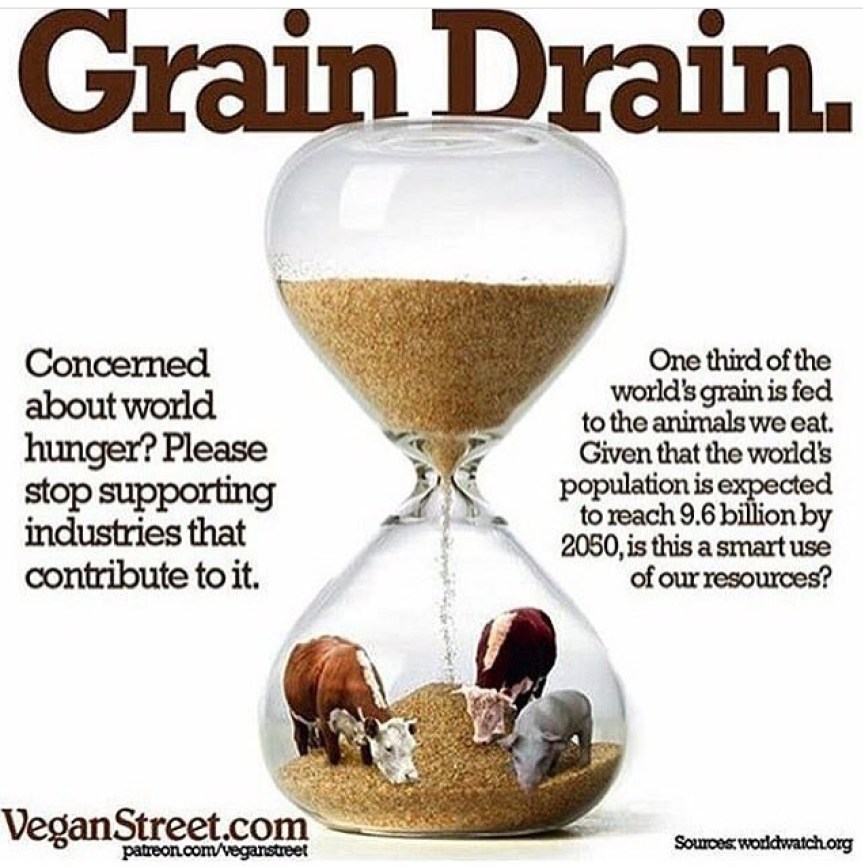
Growing Food to Feed Animals to Feed Us!

img_6540

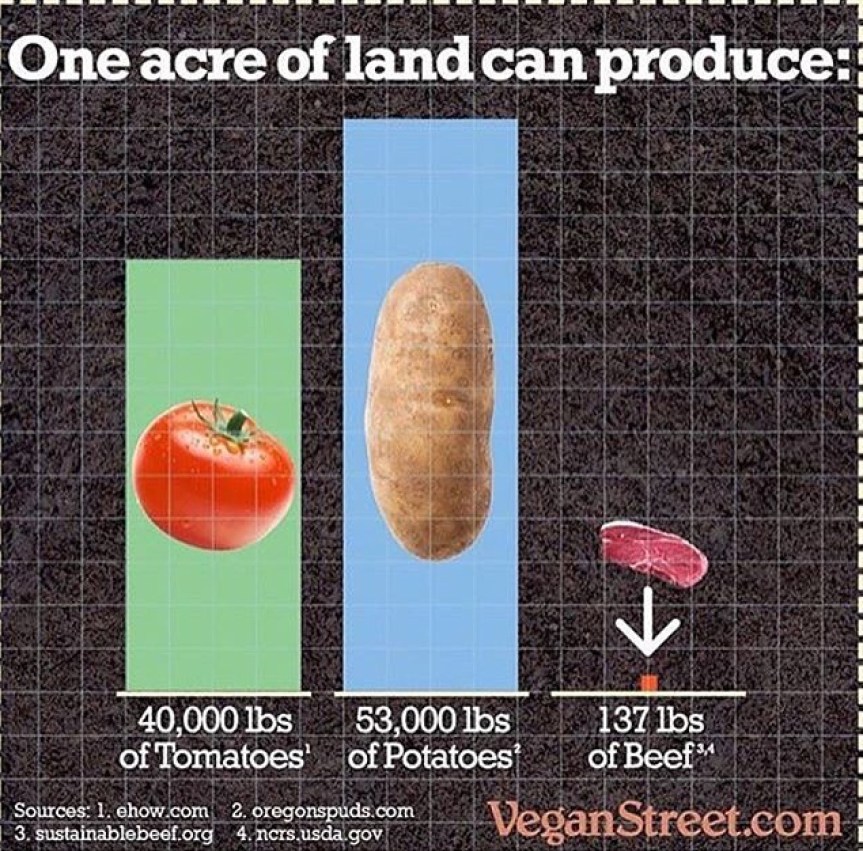
One of the reasons I first became vegetarian many moons ago was because it didn’t seem right to me that so much land was given over to growing crops to feed animals to feed us when we could just cut out the middle ‘man’ and just eat the crops! When there are so many starving people, it seemed so inefficient and such a waste of resources.

Here’s another graphic to illustrate the point:

img_6533

Developing Countries Having to Grow Cash Crops for Animal Feed in Developed World:

Another reason I became vegetarian was that so many poor countries in the developing world have been forced to grow cash crops to sell cheaply to Western countries for animal feed in order to pay off unpayable loans when they should be using them to feed their own populations and earning appropriate prices.

img_6542

Overuse of Antibiotics and Bacterial Resistance:

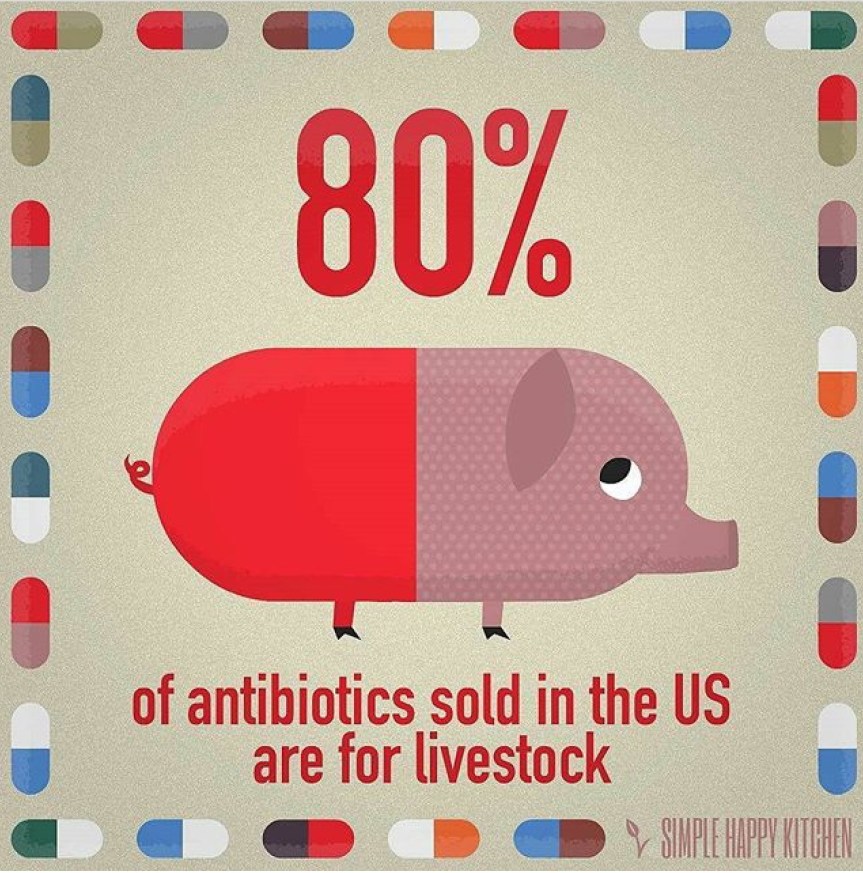
A major concern for human health and that of livestock is the overuse of antibiotics. 

img_6543

This is a shocking statistic! This is bad for the animals, bad for the environment, bad for our health. There is widespread concern about resistance to antibiotics and this is the main reason, the antibiotics given to animals end up in our food and the bugs are getting wise to them.

Last but not least is the issue of genetically modified feed and hormones used in the meat and dairy industries. Wherever you stand on the use of GMOs in food, the widespread production of single crops and consequent depletion of the soil, there is great concern among the scientific community as well as environmentalists about how adding and removing genes to alter the behaviour of plants and crops will affect the behaviour of our own genes and dna, as well as that of the animals, birds and insects that feed on them and the consequent ecological ramifications.

Monsanto’s genetically engineered bovine growth hormone is banned in most industrialised countries but is widely used in the US dairy industry. Milk from such cows contains higher levels of a hormone linked to breast, prostrate, colon, lung and other cancers. *

Many other GMOs are banned in most other developed countries, being linked with various cancers and other inflammatory conditions, as well as environmental pollution and crop contamination, but deemed safe in the US. There is little to no regulation of their use and unlike European consumers who have food labelling, for the most part US consumers are not privy to the information. (For example, a US company is about to begin selling packaged GMO sliced apples that don’t go brown in some mid-Western stores but consumers will not be told which stores nor will they be labelled as such).

A series of programmes made about these issues were forced to be postponed and the makers threatened.

There is an informative post on this here by The Organic Consumers Association and another on Unregulated gene editing by Natural Health 365.

img_6595

Just after I published this post, I came across this quote on Instagram which starkly but neatly sums up all the issues:

img_6596

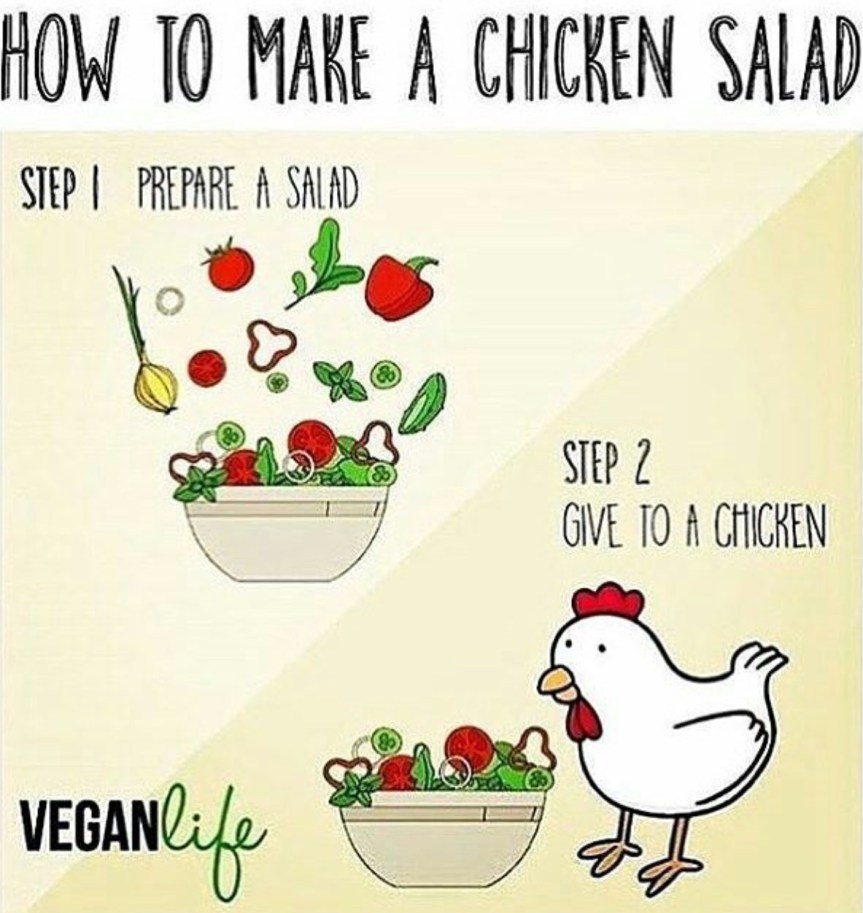
Finally, on a lighter note:

img_6589

https://www.theguardian.com/environment/2016/mar/21/eat-less-meat-vegetarianism-dangerous-global-warming

https://ourgreennation.org/2017/01/02/gmos-in-dairy-institute-for-responsible-technology/

Copyright: Chris McGowan

It’s January: S.A.D.? Do What You Love!

I bought a new mug the other day. Well, actually, it’s a rather large cup that you need two hands to hold, one of those Friends-type ones that you can snuggle up with, full of hot chocolate*, in front of a cosy fire. It’s nothing special. It cost 99p in a local shop and is both dishwasher and microwave safe. It was what was written on the front that resonated.

I don’t usually like things with slogans, but this one says:

‘Do what you love!’

img_2967

Being January, with its cold and damp grey days, and being a little susceptible to Seasonal Affective Disorder, I have learned to try always to have a project on the go to absorb my attention and give my brain something else to contemplate other than when is the sun ever going to wake up and the garden turn green again?

In the past it’s been family history research: when I finished my own, I helped someone else. I try to catch up on letter-writing too. Real letters with real ink written on real paper! I love to use a fountain pen, and this year I have my precious old one sent to me by my primary school teacher, Evelyn (you can read about it here).

21f65416-e275-4687-a6cc-13eef10a45aaI’m currently on my second week of a juice plan, so that has occupied me somewhat – and made me get some much-needed early nights! – but I needed something creative too.

Every year, when we take down the Christmas cards, I put them away for recycling and reusing in November for next Christmas. But I always think I should do it now because November is always such a busy month with all the other preparations and my back really suffers so that I’m always in pain at Christmas.

img_2968This time, when I saw the mug, it was like a message from the universe! So, here I am, doing what I love, making Christmas cards in January! Oh, and drinking my favourite liquorice and cinnamon tea.

This is also the time of year when the professional cyclists dust off their lycra, don their new team strips and bring us some much needed sun from Downunder!

The Tour Down Under began this week in Adelaide, just what I needed: sun, culture and men in lycra – and leading the family Velogames league after Stage 1 and 2 (I don’t even cycle, they take it very seriously) <wicked laugh!>

So I may be a little preoccupied for a while … with the cards I mean 😉

Time for my next juice, cheers!

img_2957

What do *you* love to do during these winter months?

*Recipe for Spicy Raw Hot Chocolate with Hemp Milk (or nut milk).

Copyright: Chris McGowan

Where to Get Nutritional Advice for Young Vegans and Newbies

Just a quick post to pass on this link fom The Vegan Society which gives nutritional advice for young children, 11-18 year olds and those new to vegan eating. It includes the importance of breakfast, calcium, omega 3, Vitamin D, iodine, B12 etc. with suggestions for meals and sources of these nutrients.

It is by no means comprehensive and it is important to do your own research regarding the issue of using supplements or not.

My view is that it is always better to get your nutrients from real food where possible, supplements come in such a variety of forms, strengths and quality, often have fillers and they are expensive and not always absorbed sufficiently by the body.

Isolating particular nutrients doesn’t always work since when they occur within real food, they are accompanied by lots of micro-nutrients which aid their metabolism and absorption, which isn’t always the case with supplements.

This is why it is important to consume foods containing Vitamin C with foods containing iron, for instance. That’s also the reason not to peel where appropriate as these micronutrients are found just under the skin.

However, there are cases where supplementing might be appropriate, but it is wise to seek advice from a qualified practitioner.

This article is a good start, along with Teen Vegan, a safe not-for-profit social network for 12-19s with lots of advice, opportunities to volunteer making care packages for local homeless people and summer camp activities.

Another great resource is Vegan Fitness TV (recently renamed Family Fizz TV) on YouTube. They are a family of four, the parents are very into fitness, training etc but are very down-to-earth, using convenience foods as well as fresh foods and regularly test out new products. The two young girls in the family also have their own channel.

Vegan Kids (What an 11 year old eats in a day)

Vegan Kids (What a 5 Year Old eats in a day)

The two sisters do their own videos, they are delightful, so confident, lively and have a lot of fun.

Don’t forget, all the recipes on this blog are Vegan and Gluten-free and and you can find additional advice on Becoming Vegan in the blog Menu.

Copyright: Chris McGowan

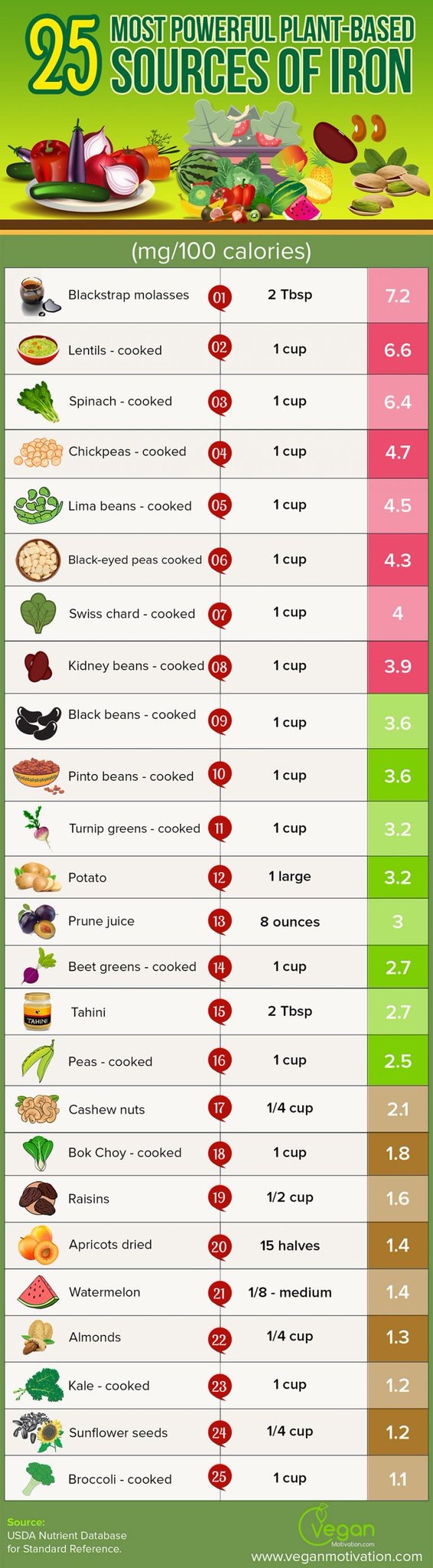
Where Do I Get Iron on a Vegan Diet?

Here:

img_2925

Plus Figs, Dried Peaches, Mangoes, Goji Berries, Golden Berries, Spirulina, Watercress, Moringa Powder, but best of all for chocolate lovers is that Dark Chocolate (over 75%) and Cacao contain lots more iron than beef!

Other sources of iron include wholegrains: Quinoa, Barley, Bulgar Wheat, Oats, Rice. Other Nuts: Macadamias, Walnuts, Pecans and Pistachios. Homemade Nut Milks (see the Menu for recipes). Other Seeds: Pumpkin, Squash, Chia, Hemp. 

Plant sources of iron are not as easily absorbed as animal sources but it is simple to obtain enough through eating a rainbow of foods every day.

In fact, vegans with a varied diet consume more bioavailable iron than meat-eaters and vegetarians.

Dairy milk interferes with the absorption of iron.

There are many more plant-based sources of iron, even in small amounts, so eating a wide variety of foods will do the job.

Vitamin C aids the absorption of plantbased Iron, and if you’re on a healthy vegan diet full of fruits and vegetables, this will not be a problem at all.

Sprouting enhances the bioavailability of iron as well as other essential nutrients, including Vitamin C to aid absorption. It is easy to sprout all kinds of beans and seeds – we sprout mung beans, alfalfa, broccoli, lentils, chickpeas.

My post Sprouting for Health, Energy and the Environment! will show you how, and provide more information on the benefits of sprouting.

Please Note: It can be dangerous to take iron supplements unless under the supervision of your doctor.

Vegetarian Times  have a great article on How Much Iron is Enough and how to get the required amounts.

One Green Planet have a good article on Ten Plant-based Foods Packed With Iron.

Copyright: Chris McGowan

Where Do I Get My Protein on a Vegan Diet?

Here:

img_4582

And here:

(I would add Nutritional Yeast, Kale, Sunflower seeds, Romaine Lettuce, Sprouted Seeds & Beans, Mushrooms and Corn to that last)

img_6548

The truth is, it is extremely difficult in Western society to be deficient in protein.

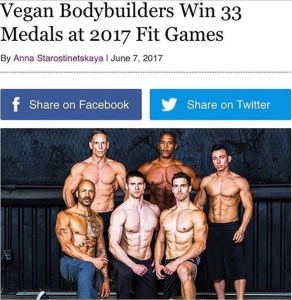
You don’t even need thick steaks if you’re a bodybuilder or any other kind of meat or dairy product if you’re a top-notch athlete: there are many top bodybuilders, ironmen, ultra-marathon runners and other sports people who are vegans.

IMG_7912

Several members of the US Rio Olympic team are on a plantbased diet. Champion tennis players Serena and Venus Williams are on plantbased diets and Novak Djokovic recently opened his own vegan restaurant. Arnold Schwarzanegger is advocating transitioning to a plantbased diet! Former President Bill Clinton changed to a vegan diet when he had bypass surgery. Carl Lewis, champion athlete, also competed on a vegan diet.

img_6370

Almost all wholefoods contain some protein to varying amounts, so all you need to do is eat a wide variety of *real* foods, as opposed to processed, chemical-laden sugary ‘foods’ that call themselves vegan and you will get all the quality protein and nutrients you need.

Excessive protein intake can overload the kidneys, make them work harder and cause dehydration.

Research from Australia and the US shows that a varied vegan diet is healthy for both children and adults. Even the the latest US eating guidelines advise more plantbased foods.

I had a meat-eating pregnancy and a vegetarian pregnancy, guess which was healthiest and easiest? The vegetarian one by far. My children were brought up vegetarian, one has always been a keen sports enthusiast and an on-again-off-again vegan, athlete, orienteer, climber and cyclist, while the other has done gymnastics, horse-riding, running, become a lifeguard and gym enthusiast, but nowadays mostly enjoys yoga, swimming and cycling.

One family member has to have a low protein diet for medical reasons and has been plantbased all his life, he’s an outdoor activities leader and specialises in canoeing and climbing.

The babies and toddlers in our family are initially brought up vegan, until they want to choose foods for themselves. Even the ones who choose to occasionally include meat still have a mostly vegetable and fruit content to their diet and all are active, with the older ones being keen cyclists, swimmers, basketball players and Kung fu exponents!

Vegan food is not all brown and boring!* (see below for links to recipes).

It’s mostly about educating yourself and cooking from scratch as much as possible, but you can still find quality vegan convenience food and snacks. And you don’t have to spend hours creating special meals. That certainly wouldn’t work in our household! There are recipes in the blog menu for both savoury, sweet and raw vegan meals as well as some healthy snacks. Instagram is also a great place to find vegan accounts and websites for advice and recipes.

Resources: Vegan Family TV a YouTube channel run by a couple with two young children, it’s fun and informative about their everday lives as vegans. They regulalry try out new products and the girls do their own broadcasts.

The Vegan Society has an article which includes protein requirements and protein sources.

PS Here is a link to a short, informative article about the current trend for protein shakes, protein-added products, the possible overdosing on protein and its feared health repercussions in 10-15 years’ time, especially on teenage boys and men:

Are You Overdosing On Protein?

*See 3 Vegan Meals with Chilli, Quinoa, Tacos & Steamed Veg (but no Quorn!)

Rocket (Arugula) Salad with Sweetcorn, Walnut Slaw, Crisp Red Apple & Lemon Tahini Dressing

Berry Chia Breakfast Jar

Warm Apricot & Ginger Rice Salad with Tamari-Splashed Garlic Mushrooms

Copyright: Chris McGowan

Jumpin’, Jivin’ an’ Jiggin’ About: Your Home As Your ‘Gym’!

img_6025

We all know any kind of movement is good for us.

We do, don’t we?

(Can’t hear you at the back of the class!) 

At this time of year especially, articles, tweets, tv programmes, Instagram memes all shout at us to get our bodies moving.

Just in case you’re still in any doubt or denial, here is a list of proven benefits:

  • it gets the heart pumping
  • improves circulation
  • builds muscle and bone which improves balance – especially important for those of us no longer in the first flush of youth
  • builds strength and stamina
  • creates endorphins which improves our mood, helps us feel better and therefore helps diminish those January blues and even depression.
  • makes you feel more alert and energetic
  • aids mental clarity, making us more productive and creative at work and home.
  • helps prevent lifestyle diseases like Type 2 diabetes through better control of blood sugar levels
  • helps keep our weight in check – if we also keep an eye on what we eat.
  • helps keep joints mobile and flexible

So, now you really do know that exercise is good for you, you can’t claim ignorance as your get-out clause!

But don’t worry, this post is not about going all out on the crossfit machine or hefting eye-watering weights at the gym. It’s all about movement and fun!

At this time of year, when the Christmas season is over, we feel overfed and lethargic, Spring is in the air and many of us start making plans to go to the gym, start running or take a zumba class.

Trouble is, in the cold months, our resolve can soon start dying a slow death. It’s cold, wet, dark, and miserable. The woodburner or the tv and a glass or cup of something warming are far more attractive. All that money spent on gym fees or trendy neon fit-wear may as well be flushed away for all the use we make of it.

Unfortunately, many of us have also had negative gym experiences or are old enough to remember the torture of school PE classes: being made to run cross-country in freezing conditions wearing t-shirt and shorts, inadequate footwear and with little or no preparation, the booming voice of the wrapped-up PE teacher in our ears decrying our efforts and urging us on, drill-sergeant style. (Anyone who has seen the film ‘An Officer and a Gentleman’ will know what I mean!)

It’s also often difficult if not impossible for many of us to embark on formal exercise regimes due to having small children or sick family members or because we have physical problems of our own or simply can’t afford the expense. So we accept that’s how it has to be and get on with it, skipping over all the articles we see urging us to move more and diverting our eyes from all the pony-tailed, fitbit-wearing runners dashing past the window.

But it doesn’t have to be that way. No more guilt at being a trainer-free home-bod.

Hooray! you shout.

Hang on, you’re not getting off that easily! You still have to move about, just not in a gym or on the road. 

Here are some tips to get it all jiggin’ about:

  1. Your home can be your gym and everyday items your equipment. Little or no expense, warm environment (less chance of injury), relative privacy (though maybe not privacy from your relatives 😉), win-win situation. Your stairs can be your step-exercise, bottles of water or tinned goods your weights, your cd player your zumba instructor.

2. You can even incorporate exercise into your everyday activities.

And no-one needs to see you doing it!

According to the BBC programme ‘Trust Me, I’m a Doctor,’ * a group of people over 40 – and therefore losing muscle, I think the oldest was 67 – incorporated exercise into their daily activities. Over a month on average they gained 3% more muscle, 12% more muscle strength, 13% more muscle power and 4% more grip strength.

So how did they do it?

Visit the website to see in detail, but basically:

  • squats and standing on one leg while brushing their teeth
  • heel-raising while washing-up
  • lunges while vacuuming
  • arm curls with juice cartons or tins
  • wall presses.

You get the picture.

I would add to these:

  • using the stairs as often as possible
  • doing step-ups, and also hanging your heel off the edge of the step to stretch your calf muscles and tendons
  • standing up from a chair and sitting back down without using your hands during advert breaks while watching tv or sitting at your desk
  • doing a walking circuit of your home as often as possible
  • in an upright chair with arms, press down on the arms and raise your bottom from the seat for as long as is comfortable
  • even on your commute, on buses, trains or planes, you can raise alternate knees, toes and heels (maybe not in a car – unless you’re a passenger!)
  • on fine days, take a turn around the garden, up and down your driveway or around the block, look up at the sky, the trees, the birds, breathe and smile!

Exercising needs to be fun too or you’ll never stick to it. Here comes the Jumpin’, Jivin’ an’ Jiggin’ About bit! (At last!)

3. One piece of exercising equipment I would recommend investing in if you can manage it is a rebounder. You don’t have to jump like an Olympian!

Rebounders are not trampolines. They are not as springy and provide more resistance. And kids please note: don’t even attempt to do somersaults! Parents please note: children should always be supervised because they *will* attempt to do somersaults!

image

NASA-approved, this method of exercising is accessible to most people if you start off slowly and simply, just gently bending your knees then graduating to lifting your heels and low bouncing before trying anything more energetic.

A couple of rebounding sessions a day exercises all parts of the body, gets your lymphatic system moving – strengthening your immune system and clearing out waste and toxins – and makes you feel more alive.

And it’s great fun.

Kids naturally love trampolining and this is great for getting them to exercise during the winter months when they can’t use the one in the garden. It tempts them away from their screens for a while which is always a good thing. Even the smallest members of our family make straight for it when they come for a visit. They are great family fun. (Again, children should always be supervised).

The Juicemaster website* sells various sizes of rebounders, the smaller ones fold up and have a carrying case. I can vouch for their quality and endurance.

4. Just dance like no-one is watching!

With or without a partner, dancing with reckless abandon is the best way to forget your worries and feel alive! Put on your favourite music, the one you like singing aloud to at high volume and just go for it! (see video below).

You can jig about when you’re in the kitchen – my regular readers will know that I often like to attach a YouTube track to accompany my recipes – or when you’re cleaning or tidying up, doing the ironing, doing a bike repair (one for you, K and S!😉). I have even seen my neighbour doing her ironing to the accompaniment of reggae music in her back garden in the summer, not caring a jot if anyone saw her.

In general, whatever your age, state of health, fitness or finances, any movement is better than no movement.

(I realise there are certain health conditions where this may not be appropriate).

5. Many of us, especially older people, get stiff joints and cold legs from sitting. While reading, doing the crossword or watching tv, you can raise your knees and heels up and down, rotate your ankles and wrists, stretch out your fingers and make a fist, walk about during the ad breaks even if it’s only to get up and make a cup of tea. Clench alternate groups of muscles and release. Do shoulder rotations.

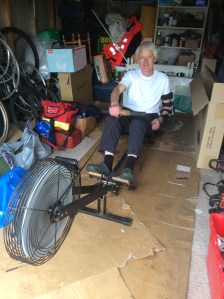
img_2421My husband exercising on a borrowed rowing machine in the garage with a broken arm. He also used one of those stretchy bands that physios use which come in different levels of flexibility.

Do what you’re able and what you enjoy – with your family, friends or on your own. Walk, cycle, laugh, sing – they all exercise your body inside and out.

Just do!

6. Oh, and btw, apparently, exercising is more effective in burning fat if men exercise on an empty stomach and women after eating. (I can hear all the women cheering from the gallery!)

Ps Whatever form of exercise you do, be sure to warm up and stretch first,  and ease into it – it won’t do you much good if you pull a back muscle or sprain an ankle in your first session!

PPs If you have any concerns about whether or not you should follow any of the advice above, please do talk to your doctor.

*Trust Me, I’m A Doctor – you can watch on BBC iPlayer

*Juicemaster: Rebounders

(Thanks to Clive at Take It Easy for putting me on to these guys!)

Copyright: Chris McGowan

Veganuary

January has been designated Veganuary and even has its own website! 

It was such a success last year that I think it is probably here to stay.

40,000 people have signed up to try being vegan for a month and the website is there to provide support, advice, product websites and tasty recipes for people wanting to increase the plant-based element of their diet and reduce meat and dairy. 

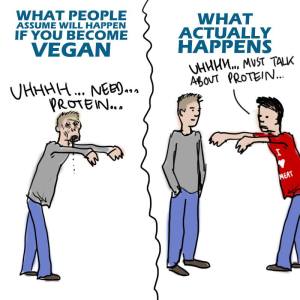
Cartoon by www.vegansidekick.comEveryone has their own food journey, we are all at differing stages and are there for different reasons, whether it be health, ethics or environmental impact.

I am not about to go through all the whys and wherefores, others have done a much better job than I can, but I have decided to provide a Vegan category to house the information about being vegan if people wish to look it up.

img_6522

(Photo from The Vegan Community)

Recently, I published Hanna’s post Plant Powered New Year which was her response to a specific question about whether a diet containing meat would have an effect on psoriasis. Hanna suffered with appalling psoriasis and is now mostly vegan after ridding herself of the misery of itchy, inflamed skin through juicing and a plant-based diet. Hanna was quite forthright in her language, which may not appeal to some, but she has had a rough journey to where she stands now as a beautifully healthy, energetic young woman and has just had her first book published called ‘Radiant’. It includes her story along with beautiful photography and tasty recipes to help achieve the same results.

Today, I have decided to provide links not only to her post but also 3 others which take a more softly-softly approach and give a guiding hand to those just beginning to look into the subject of ‘going vegan’.

The first is Rachel at Healthy and Psyched5 Tips For Transitioning To Veganism where she is at pains to reduce the guilt element so often present in such articles. Rachel says basically that you are not a bad person because you unwittingly – or even wittingly – eat something that has dairy in it at a family party for instance, and my favourite is not to throw away all your make-up, which is expensive to replace and such a waste, and which is exactly what I did!

The second post is from Feminine Boutique BlogHow To Go Vegan in 4 Steps This post gives links to sites, YouTubers and books where you can find the information you crave and the support. It is short and there is nothing to scare the horses (pun intended!) It too is written in an easy-going style and isn’t at all ‘preachy’.

Another interesting post is from Our Green Nation2016’s Top 10 Vegan Moments which lists interesting topics such as the American government, scientists and doctors giving vegetarian and vegan diets the thumbs up as being healthy and suitable for any stage in life, while the latest American Nutritional Guidelines are the most vegetarian-friendly ever; they feature the Sainsbury’s ‘Gary’ vegan cheese furore and the members of the USA Olympic team who have plantbased diets including a weightlifter.

Finally, there is even a website for teenage vegetarians and vegans: http://www.teenvgn.com It is a great site, describing iteslf as a social network for teen vegetarians and vegans, providing a safe place for 12-19 year olds to obtain information, recipes and exchange ideas. They even run a summer camp every year full of activities for 11 a 17 year olds. They encourage volunteering and put together care boxes for homeless people in local areas. They are sponsored by several reputable companies and supported by The Raw Chocolate Company.

img_6523

Going vegan doesn’t mean going boring! There are many websites and Instagram accounts with colourful, balanced vegan recipes. You can also check out the vegan recipes in my menu.

The Vegan Society will provide answers to most of your questions.

image

Copyright: Chris McGowan

What To Do If You Feel Hungry on a Juice Plan or Don’t Need To Lose a Lot of Weight

imageThis morning I was asked by Siobhan of Paris Here And There if there is anything she can do to avoid the hunger pangs on a juicing program and also to prevent her losing weight unnecessarily.

If you read my post yesterday, you’ll know that next Monday I am joining Jason Vale’s ‘Big January Clean-Up’ which involves doing the first 14 days of his 28 day SuperJuiceMe! plan (there is still time to sign up via the Juicemaster website, all coaching videos, shopping lists, recipes are free).

First, let me explain about hunger pangs.

It is normal to feel hunger in the first 3 days of a juice plan.

More often than not these are withdrawal pangs, not genuine hunger. Your body is getting everything it needs from the nutritionally balanced juices, blends and smoothies. What it is not getting is the caffeine, sugar, alcohol and hopefully nicotine it has become dependent upon and it is shouting at you very loudly about this restriction, as with any withdrawal from addictive substances.

And let’s make no bones about it: all these substances are addictive. Sugar has the same effect on the brain as crack cocaine and heroin!

Here are some tips and advice:

1. The way to reduce these withdrawal symptoms (headaches, cravings) is to taper off and finally quit in the 2 weeks before a juice-only program.

2. Once you begin the plan, keep well-hydrated, using herbal and fruit teas, warm water with a slice of lemon, as well as plain water; rest – go for walks in the fresh air, do yoga, rather than sessions at the gym – and watch or read inspiring films and books to keep you motivated. (See the suggested list at the end).

3. If you genuinely feel hungry, you can’t sleep for tummy rumbles etc. there are emergency rations you can turn to (see later).

4. The point of the plan is to give your digestive system a rest and allow your body to repair, renew and rest, so try to resist for the first 3 days.

5. Keep yourself occupied so you’re not thinking about food all the time.

6. Have your juices ready and don’t wait until you’re desperate before having them, then you won’t be tempted to grab a sugary snack or bag of crisps. Also, sip your juices slowly through a straw.

7. Try to find a juice buddy. If this is your first time, support is vital and you can either persuade a friend or family member to join you or find amazing support on Jason Vale’s Facebook page, where you can ask questions and get advice, or on Twitter/Instagram.

8. Keep reminding yourself why you’re doing it. Read up on the health benefits of juicing and arm yourself to fend off all the doubters and sceptics who will try to undermine your resolve.

9. Don’t be put off, the results will speak for themselves and will silence the naysayers.

10. Over 25 people, including some who tried to put me off, started juicing after they saw the amazing results from my first plan.

*

For those who don’t want or need to lose a lot of weight:

When I did the last 14 day juice challenge, I didn’t need to lose weight but this time after a cold, too much comfort food and lots of family visits/festive food I could do with it!

However, there are those who just want the re-energising health benefits or want to clear up their skin or reduce aches and pains and who have no wish or need to lose weight. I have compiled a list of things you can do if you fall into these categories.

You may still lose some weight just by the fact that you have cut out a lot of snacks and high fat/sugary foods during your juice plan, but you will slowly regain what you need when your body readjusts to what is normal eating for you.

You will generally only lose the weight you need to lose. 

I do these juice challenges 4 times a year. My first 2 times I lost  2 1/2 stones (35lbs) altogether. Now, I lose about 5 lbs as I don’t need to lose any more.

And for those who really do suffer genuine hunger pangs, there are things you can eat to alleviate them, but only in a dire emergency!

Tips for emergency rations or to prevent unwanted weight loss:

1. To allay hunger pangs or to avoid a big weight loss, stick to plant foods and oils as your emergency rations. You can add an extra juice, or a tsp of flax oil or coconut oil to a glass of juice.

2. To prevent digestive issues, I reiterate: stay away from processed and sugary foods, meat and dairy, coffee and alcohol.

3. Half a ripe avocado either on its own in the evening with lemon juice and cracked black pepper or blended into a couple of juices a day (1/4 at a time) will usually do the trick. It is normal to feel hungry in the first 2 to 3 days but then your body adjusts.

4. Hunger and thirst can be confused. More often than not, it is hydration you need rather than food. Again, keep hydrated using herbal and fruit teas as well as plenty of water.

5. You can add a tablespoon of ground organic linseeds (or other seeds) to your juices (this also helps if you have any problems with constipation).

6. Half a very ripe banana in the evening can also help.

7. If out and about and the avocados and banana are not an option, a healthy version of a fruit bar can help, but make sure it does not contain refined sugar, dairy or other additives, just pure fruit and nuts.

8. My go-to emergency ration is one of Jason’s ‘Juice in a Bar’ snacks. These really do replace a juice if you need to and are very filling.  Usually, I can manage only half.

9. You could add a higher calorie vegetable to your juices like sweet potato – I use these often in my own juices (usually to replace parsnips!)

10. Whatever you decide, always chew slowly and thoroughly, otherwise your tummy will object if it is already adapting to the juice program.

Bonus tip: Try adding some good quality pea or hemp protein powder to some of your juices to stave off the hunger and give your juices some extra oomph!

Most of all, remember that if you have to miss a juice or you do feel the need for extras, it doesn’t mean you have failed and you have to give up! Just pick up where you left off. You will still gain the benefits. Even if you just have one juice a day and cut down or cut out the processed, sugary stuff, you will feel more energy, your skin, hair and nails will benefit and if you need to lose some weight, then this will help.

img_3462

*

I hope I have covered everything. If you have any other questions please ask in the comments and I will try to address them in another post. You may find the answers already in the Juicing Tips section of the Menu.

Finally, a list of films, books and websites for motivation and support.

These websites are excellent for books, articles, recipes, information, support

Juicemaster I recommend all of Jason’s books for their down-to-earth, lighthearted style in explaining how food works, how the food and pharma industries work, how juicing works.

Reboot with Joe Cross Aussie Joe is inspirational for his own journey, documented in his film Fat, Sick and Nearly Dead. He also does guided reboots and his website has a wealth of information and advice.

The Natural Juice Junkie Neil is a leading Britsh juice exponent and lifestyle coach. His articles are informative, short and easy to read. He also does guided juice challenges.

My Goodness Recipes (Hanna and Jason Vale both rid themselves of the terrible symptoms of psoriasis through juicing and offer free plans on their websites)

SuperJuiceMe! The Documentary  Jason Vale took 8 volunteers with 22 different diseases, some life-threatening, which were not improving with allopathic (conventional) treatment, some very overweight, others not. He put them on a juicing regimen of fruit and vegetables for 28 days. This documentary follows their path and I defy you to watch and not reach for the tissues then quickly determine to make some changes to your lifestyle.

Food Matters TV From 11th January, 2017 you can watch both the Food Matters and Hungry for Change films free for 5 days via this website. The Food Matters team have an excellent website bringing regular articles on current health topics and research as well as healthy recipes and tips for an all round healthier lifestyle, including environmental changes.

My Post How I Juiced My Skin Clear: A Rash Decision?

Copyright: Chris McGowan