Love Brazils? Beware Potential Selenium Overload!

I got a shock the other day. I have been vegetarian for 40 years and was confident I was never short of any essential vitamins or minerals. I paid attention to what I ate, rarely ate junk food and took supplements when I felt the need. All tests have always come back normal. Since becoming vegan a year ago, I have researched which areas of my diet may need more rigorous attention and apart from a B12 supplement, I decided it was far better to eat a balanced, plant-based diet than to buy expensive supplements that I may or may not need and may or may not absorb on the off-chance that I may become slightly deficient.

 I had read that a good source of Selenium for vegans was Brazil nuts. Fantastic, I thought, I love Brazil nuts. They became my favourite morning snack. I would eat at least 6 and maybe 10 a day.

When I decided to research and write a series of posts on essential vitamins and minerals, I read about Selenium in a little more detail. That’s when I got the shock.

The BDA – the association of British Dieticians – recommends eating only 1-2 Brazil nuts a day and no more than 3-4 due to the possibility of Selenium toxicity!

The Adult RDA for Selenium is 55mcg (micrograms) with an upper limit of 400mcg.

I was consuming about 30g of Brazil nuts, which is approximately 575mcg of Selenium per day!

image

(100g of Brazil nuts per month provides the requisite amount).

Selenium is required for healthy thyroid function, to strengthen the immune system, protect cells from damage, and reduce the risk of cancer and heart disease. The amount of Selenium in our foods has depleted due to poor quality soil and contaminated water and varies considerably according to where you live.

However, studies conducted on vegans in the UK, Germany, US and New Zealand (the latter has very low levels of selenium in the soil) showed that the majority were taking adequate amounts of Selenium.

Symptoms of Selenium toxicity include:

Hair loss, fatigue, irritability, white spots on nails, gastrointestinal disorders and neurological damage.

Stopping the excess Selenium and drinking lots of water usually reverses the damage.

Fortunately, I seem to have avoided these problems but I will miss my favourite snack.

Sources of Selenium:

Brazil  Nuts: 30g = 575mcg

Wholewheat Spaghetti 215g = 56mcg

Couscous: 140g = 39 mcg

Shitake Mushrooms 85g = 21 mcg

Wholewheat Flour 30g = 20mcg

Sunflower Seeds 30g = 16mcg

Sources: The Vegan Society

Rich Vegan Foods

Copyright: Chris McGowan

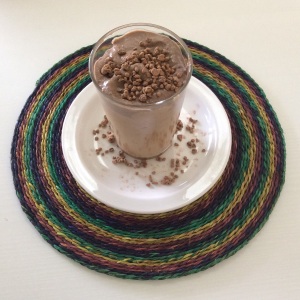
Walnut & Banana Smoothie with Raw Chocolate Mulberry Chips

This is a really thick smoothie – you will definitely need a spoon! – so feel free to adjust the amount of liquid if you prefer it thinner. It is intended as a meal replacement.

image

Walnuts are a powerhouse of nutrients: protein, Vitamin E, B vitamins, healthy oils, fibre – good for the brain, good for the heart. Apricots contain iron and Vitamin A while Romaine, Quinoa, Sunflower and Hemp Seeds are also good sources of protein, Banana has potassium – also good for your heart – and Cacao, well, what doesn’t it have and what’s not to like?!

All ingredients are organic where possible.

Ingredients

Small Banana

4-5 Organic Dried Apricots, rinsed

1 Tbsp Quinoa Flakes

3 Large Romaine Leaves, washed and chopped

1 Tbsp Sunflower Seeds

1 Tbsp Raw Hemp Seeds*

1 Tbsp Raw Cacao Powder *

Handful Walnut Pieces or Halves

1 Tbsp Dried Mulberries*

1 Tbsp Raw Chocolate Mulberry Chips* to sprinkle on top

1 Small Glass Fresh Apple Juice + some filtered water if you want it a little thinner

Blend all except the extra Raw Chocolate Mulberry Chips, then sprinkle them on top. Sit back, relax and savour this raw chocolate smooth sensation!

This is for you, K! 😉

*from The Raw Chocolate Company

Copyright: Chris McGowan

Make Beetroot Your New Veg Friend! (Juice Recipes Included)


image

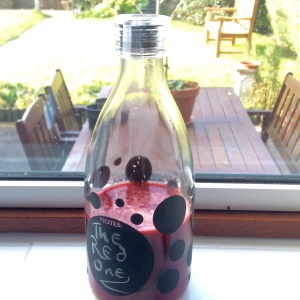
The Red One – Recipe Below (along with details of where to buy the glass bottle)

When I was at school and had school dinners, they used to give us sliced boiled beetroot with shepherd’s pie once a week. It turned the mashed potato a blushing pink. In those days we ate what we were given, both at home and at school, there were no menu options. I loved school dinners and whilst I wasn’t a big fan of boiled beetroot, it was ok. I ate it. Then in my teens I started taking packed lunches and between then and 2 years ago, not another slice of beetroot passed my lips. We never had it at home and later when I had my own family, my husband didn’t like it so we just never bought it.

Juicing changed all that. When I came to have my first juice with beetroot in, I was somewhat apprehensive. To my surprise, I liked it and given all its nutritional benefits, beetroot became My New Veg Friend.

It is advisable when you first begin juicing to add some fruit, especially lemon and/or berries, even ginger, which I still do, I’m not that hardcore that I drink straight beetroot juice! It has a slightly earthy flavour which some people aren’t keen on, although some varieties are sweeter than others. This is reduced if you remove the skin, but of course you’ll also be removing vital nutrients.

image

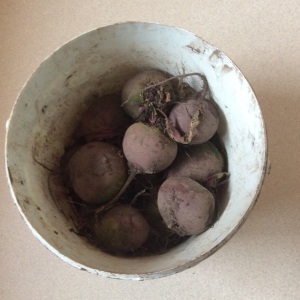
A welcome donation from our neighbour’s allotment

To my surprise, my previously juice-sceptic husband started having a daily beetroot juice too. I convinced him that it would help his blood pressure and now it has become part of his daily routine. And he doesn’t even drink it with a peg on his nose! He certainly feels healthier for it.

He gets regular exercise cleaning up after he’s made it too – for some reason, he always manages to get beetroot juice everywhere! So be warned, it stains, you’re advised to wear an apron and rubber gloves!

Just one of the many beetroot explosions in our kitchen, it even reached the ceiling once!

Beetroots are rich in iron, potassium, magnesium and folate, are anti-imflammatory, rich in anti-oxidants and are good for heart and blood health. They increase blood flow to the brain and improve exercise performance. Regular drinking of beetroot juice has been shown to reduce blood pressure.

Here’s one of the beetroot recipes we use – full of anti-oxidants, it is also anti-inflammatory, mineral-rich and has protein from the romaine leaves (see below for links to other beetroot juice recipes)*

The Red One

Ingredients

(Organic if possible)

1 Small or Half a Medium Beetroot – If organic and you’re used to beetroot, just chop the ends off, scrub well and leave the peel on

2-3 Medium Carrots, scrubbed

6 Romaine leaves, rinsed well

Thick Slice of Wax-Free Lemon – if organic, scrub and leave peel on, if not peel thinly leaving as much pith as possible.

Chunk of Ginger – size depending on whether or not you are used to the taste, it doesn’t want to be overpowering

2 Medium Apples

Half a Mango or Large Handful of Mixed Berries

Method

Juice all ingredients except Mango or Berries. Blend them into the juice, add ice.

(Beetroot is also a great tomato substitute: if you’re nightshade-sensitive and miss pasta or pizza sauce see my post Amazing Tomatoless Sauce)

*Winter Beetroot Wonder-Juice: Refreshing, Nutritious, Simple

Election Day Special Fruity Beetroot Juice

Blended Breakfast Beetroot Juice

Hot, Hot, Hot Anti-Inflammatory Beetroot & Ginger Juice!

Here’s one for beetroot soup:

Vegan, Gluten-Free Carrot, Beetroot & Basil Soup

and a burger recipe:

Nutty Bean & Beetroot Veggie Burgers with Quinoa & Redcurrants

You can even have beetroot in your porridge!

Pink Oats, Anyone?

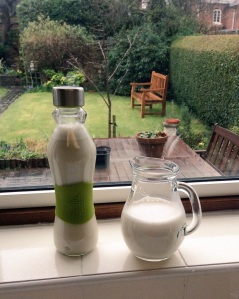
The glass bottle in the photo is by Grip and Go UK. They produce a variety of stylish glass bottles in quirky shapes, some with colourful silicone grips and easy grip lids, or you can choose stainless steel lids. The bottles are dishwasher-safe and you can even chalk on the one in the photo, great fun! Ditch the plastic!

Here’s a gentle, relaxing YouTube video of Beethoven’s Moonlight Sonata (see what I did there? 😉) to listen to while you sip your juice.

 Copyright: Chris McGowan

Amazing Tomatoless Sauce

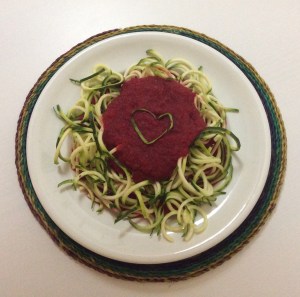
For those of us who are sensitive to nightshade foods – potatoes, aubergines, tomatoes and peppers – it can be difficult to find an acceptable substitute for pasta or pizza sauce. Until now! The lovely Hanna at My Goodness Recipes has come up with the goods yet again. I tried out her Tomatoless Sauce Recipe and it really works. It keeps well too. Give it a go, you’ll be so glad you did ☺️👏🏻

Here’s my version with zoodles:

image

Ps Her photos are much better!

Copyright: Chris McGowan

Hanna Sillitoe's avatarMy Goodness

pasta

Okay … this has to be my absolute favourite creation ever! I know, it’s a strange one right? How can tomato-less sauce beat raw snickers cake or dreamy caramel ice cream? Trust me, it does. Not only does it taste absolutely amazing, it also contains nothing but pure vegetables. No sneaky artificial flavourings or additives. Honestly, it’s wizardry!

View original post 423 more words

B12: What Is It & Do We Need to Supplement?

After ‘Where do you get your protein/calcium/iron from?’ most vegans will sooner or later have to face the B12 question.

It is an important topic, but not just for vegans: B12 deficiency can occur in meat-eaters (farm animals are often deficient and require supplementation),  as well as pregnant women and breast-fed infants whose mothers are vegan, whilst the over-50’s can be deficient due to poorer absorption.

So what is B12, why do we need it, where do we find it, how much do we need and in what form?

B12 is a water-soluble vitamin that is one of the compounds required by the body to convert food into energy. It is required for a healthy nervous system, good bone health and in the development and protection of nerve cells and red blood cells.

B12 deficiency can have severe effects on adults, babies and children, long-term vegans, raw food and macrobiotic vegans, the breast-fed infants of vegan mothers and can lead to serious complications in pregnancy such as pre-eclampsia and neural tube defects.

Symptoms of deficiency can be fatigue, anaemia, poor concentration, gastrointestinal disorders, tingling in hands and feet, and irritability. Severe deficiency can lead to nerve damage, Alzheimer’s disease, pernicious anaemia, spinal cord degeneration and heart disease. There is a also a higher risk of bone fractures.

B12 is produced by micro-organisms and is present in the soil in which we grow our food – or at least, it used to be. A combination of demineralisation through modern farming methods and our concerns about hygiene and bacteria – resulting in the cleansing of soil from vegetables – means we can’t just rely on normal food sources: we are advised to include fortified foods or take supplements.  Well, some experts do and some aren’t too sure! More on this later.

Non-vegans routinely obtain B12 from animal sources: cooked liver, fish/seafood, poultry, eggs, milk amd cheese. However, as I said earlier, these sources are becoming less reliable and older people whether omnivores or vegans are less able to absorb the amounts necessary for healthy bodily functions.

Recommended daily amounts tend to vary from country to country, so you may need to do a little research to find out if you are getting enough.

The Vegan Society in the UK recommends eating fortified foods such as breakfast cereals, plant milks, yeast extract or nutritional yeast with every meal to obtain 3 mcg (micrograms) per day OR a daily supplement of at least 10 mcg OR a weekly supplement of at least 2000 mcg. Good quality organic Aloe Vera juice is also a good source of B12.

It is best to take little and often but the less often you have it the more your body needs, so a higher dose weekly supplement should also provide enough protection.

Traditionally, vegans have relied on sea vegetables and algae such as spirulina, nori and so on, as well as barleygrass, but there is now some doubt as to their efficacy:  recent studies have concluded that these sources are unreliable and possibly dangerous due to contamination. They are believed to contain B12 analogues which can interfere with B12 absorption and metabolism.

Most experts seem to advise supplementation.

But even this is not without controversy! Here comes the science bit: Many supplements are in synthetic form which is not as bioavailable and the general consensus seems to be that Methylcobalamin is the most bioavailable source and ideally a supplement should be a combination of Methylcobalamin and Adenosylcobalamin.

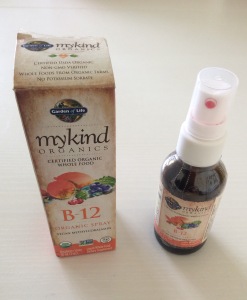
imageSublingual sprays are often preferred to tablets. Global Health Centre recommends VeganSafe B12.

I found it very hard to find an organic B12 supplement and they are very expensive. However, they do last a long time. I had to buy mine from Mykind Organics in the US. I have been taking a weekly spray of 5000 mcg for about 6 months now and my B12 levels are fine. It is raspberry flavoured and very easy to use.

I hope this has helped clarify this issue, it is difficult to be sure of getting the right information when even those trained in this area aren’t even in full agreement!  Watch the short video of a debate on the subject by a panel of experts in nutrition at the end of this article.

Sources: The Vegan Society

Forks Over Knives

Global Healing Centre

Dr Steven Lin

Copyright: Chris McGowan

“a life to which I feel myself a stranger.” -Swiss Long Rider Ella Maillart

A welcome update from Marc on his Long Saunter South through Central and South America, where he raised money and awareness for children in orphanages and special needs schools, and news of Red, his faithful steed!

vaquero's avatarThe Long Saunter South

Several months ago I returned home, to my loving family whom have been there with me every step of this journey. Still, months later it does not feel real. Taking in what happened and feeling out of place in my home town. It can be hard to process the changes that occur, not only within but the advances in the “civilised world” wifi, fingerprint recognition, smart phones, faster connections and no, I am not on snapchat. A lot can change in four years. Life seemed a lot more simple out on the road ….. however, I am not missing the chicken soup.

Lotus-Root-Rice-Bean-and-Chicken-Feet-Soup

Red, my horse, I am reliably informed is doing well, I wake every morning thinking of him, sometimes still disorientated enough that I jump up shouting his name, looking for him. He is safe and healthy with the wonderful family I got to spend time with in Ecuador…

View original post 410 more words

How To Make Almond Milk

Home-made almond milk is so much tastier than that bought in cartons and is easy to make, especially if you have a high-speed blender. We use the Optimum 9200 from Froothie easy to use, easy to clean. The Retro Super Blend can also cope well with nuts, but we tend to use that for smoothies and the Optimum for milk as it has a slightly larger capacity.

Almonds are the king of the nut world in terms of nutrients: they are alkaline and full of vitamins and minerals, including B vitamins, Calcium and Vitamin D.  1 oz or 28g (a small handful) contains about 6g of protein. Most of the fat content is the healthier mono-unsaturated type.

So, have a go at making your own, it is a very satisfying activity. Because it is a very hands-on exercise, do make sure you wash your hands and nails thoroughly before starting.

All ingredients are organic where possible. This recipe makes about 1 litre.

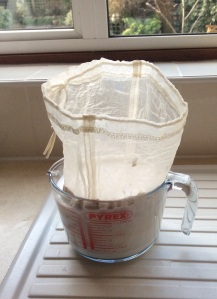
You will need something to strain the milk, we use a nut milk bag bought on Amazon and still going strong a year later. It is easy to rinse out afterwards, do it straightaway under running hot water and hang up to air dry.

Method

Soak 1 Cup Raw Almonds overnight in enough filtered water to cover them.

image

They will look plump after soaking.

Drain and rinse. The rinse water removes phytates which bind to minerals in the body and prevent absorption.

Pour the soaked almonds into the blender with:

3 or 4 Cups Filtered Water, depending how creamy you like it

1 or 2 Pitted Medjool Dates, depending on how sweet you like it

A good pinch of Pink Himalayan Salt

Optional: 1/2 Tsp Vanilla Extract

Blend on Fast for about 60 secs.

image

Strain gently through a nut milk bag or muslin cloth into a large jug.

Let it run through first, then very gently begin to squeeze. Don’t be too enthusiastic about this or you’ll end up with more on you and the work surface than in the jug! Be patient. It’s worth it.

image

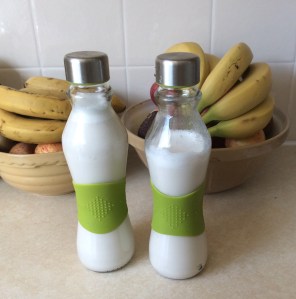
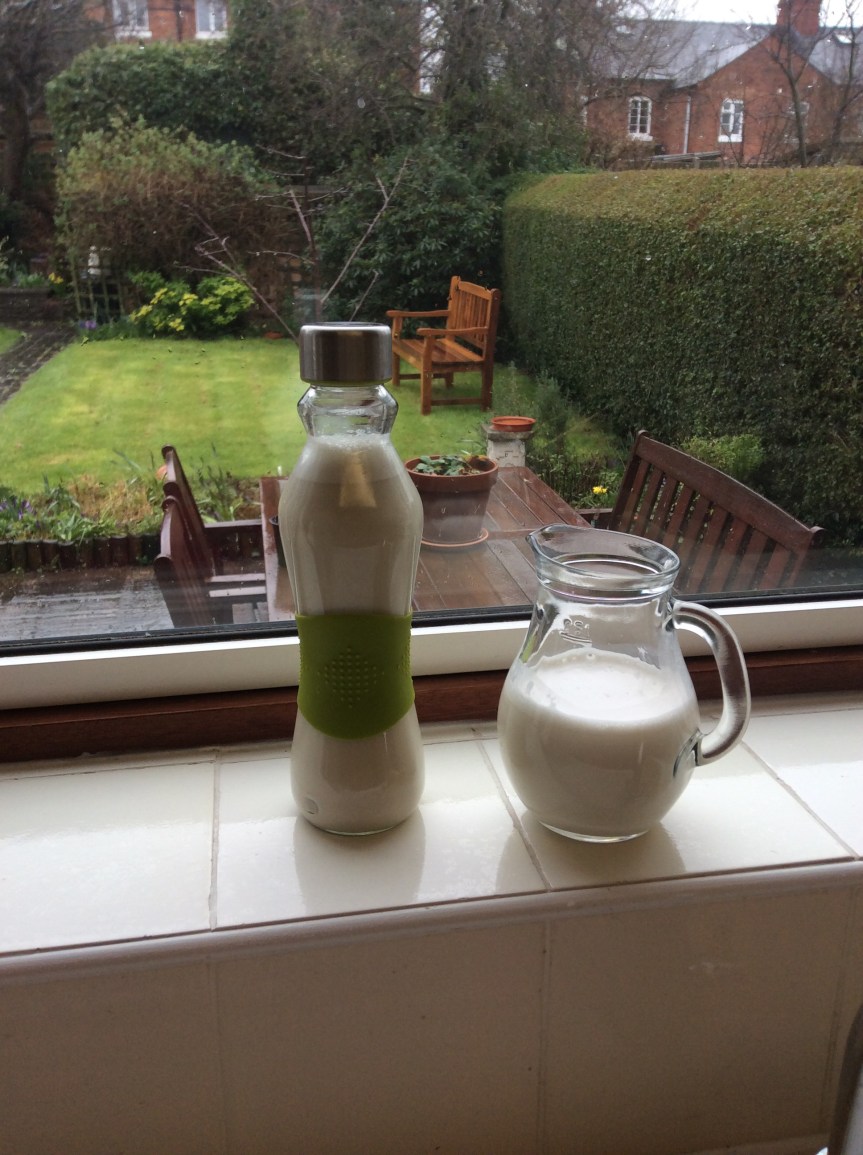
It can keep up to 4 days in an airtight jug or glass bottle (see Grip & Go below) in the fridge, but I doubt you will manage to make it last that long! It’s too good.

image

Ps You can dry the pulp on the lowest setting of the oven and use it as flour, in veggie burgers, or as it is in raw treats etc. See here for my Raw Pitch Dark Figgy Almond Slices.

Copyright: Chris McGowan

Juicing Accessories I Can’t Do Without!

As a regular juicer for over 2 years, I’ve acquired a few accessories that I wouldn’t want to do without, so I thought I’d write a post about my juicy recommendations. Naturally, there are other brands of similar items available but these are the ones I actually use and which I’ve had for the most part for all of that time.

image

After the juicer and blender, the first thing I bought was a couple of metal juice flasks. These are great at keeping juices fresh in the fridge and help them last longer by keeping them cold and away from light and air, thereby slowing down the oxidising process. Always fill up to the top to prevent air spoiling the juice, adding ice chips helps too. They are good for carrying around so long as you don’t leave them in the car getting warm. This one is from Juicemaster and is the 0.4L size. It also comes in 0.6L  and there is a Sigg equivalent too.

The next thing you need if you are using flasks of any kind is a long-handled flexible brush that will reach right down and clean them out properly. Good hygiene is essential when juicing, all equipment and accessories need to be thoroughly cleaned to prevent the growth of harmful bacteria.

image

Again, this one is from Juicemaster and still going strong after two years. While we’re talking brushes, I’d also say you need a good vegetable scrubbing brush too so you can leave the skin on your veggies.

It is always best to drink your juices through a straw to protect your teeth, but I have a problem with plastic straws: I don’t like ingesting chemicals, plastic is bad for the environment and you have to keep buying them. Instead, I found some stainless steel ones that come as a set of 4 (somehow one has disappeared!) with a tiny spiral brush for cleaning them.

image

They are available on Amazon and currently cost around £4. They can be placed in the dishwasher and sterilised.

Once we mastered juicing  we moved on to making our own nut milks (see here for Nut Milk, Shake & Smoothie Recipes), and my next must-have accessory is a nut milk bag for straining the milk from the pulp. There are several different kinds and shapes available, I got mine on Amazon. It is easy to rinse through under the tap and hang it by the drawstring to air dry. Always rinse it out straightaway to make sure it is completely clean – don’t let the pulp dry in the bag, it will be so much harder to remove.

image

Once we started making nut milk, we needed something to store it in! I prefer glass to plastic and we found a great 500ml glass bottle by Grip & Go on Amazon which, if you’re like me and have a dodgy grip, is so much easier to hold: it has a thinner middle around which is a textured silicone grip. You can get them in many colours and two sizes, they are dishwasher safe apart from the lid and they don’t leak. I originally had a glass jug with a plastic lid, but it was neither airtight nor leakproof so the milk went off quicker and you couldn’t shake it up without getting splashed.

image

I bought 2 x 500ml bottles after finding the 1L bottle too heavy. They fit easily in the fridge door and look good too. The company also do a quirky twisty glass bottle that looks even better for those with grip problems like me. Great for juices too!

Copyright: Chris McGowan

How (and Why) I Kicked the Paper Towel Habit

Pioneering the Simple Life has become my conscience these days! They tell me what I already know (and sometimes what I don’t), but don’t get around to acting upon and then I am forced to confront my insertia and do something about it. Here is a prime example. We as a family are some of the world’s most profligate users of paper kitchen towels and I admit I am mostly to blame. Dishcloths fill me with horror because of all the bacteria and take so much washing and rinsing out; when there’s a spill it’s so much easier to grab kitchen paper and just throw it in the bin. I justified my use by buying recycled amd then composting them after use. I am now rethinking this tactic after reading this post. You should too. And be sure to read about shop receipts too. BPA is toxic and is everywhere – even in our recycled paper products!

Liesl Clark's avatarPioneering The Simple Life

A few good rags,

A few good rags in a basket = alternative to paper towels. Photo © Liesl Clark

A few good rags in a basket = alternative to paper towels. Photo © Liesl Clark

a washing machine,

2-3 weeks-worth of cloth rags in line for laundering = sustainable replacement for paper towels. Photo © Liesl Clark

2-3 weeks-worth of cloth rags in line for laundering = sustainable replacement for paper towels. Photo © Liesl Clark

and an empty drawer

"Wiping Towel Drawer," under the counter right next to the dinner table, ready for wipe-ups. Photo © Liesl Clark

“Wiping Towel Drawer,” under the counter, right next to the dinner table, ready for wipe-ups. Photo © Liesl Clark

are all it took to convert my family from paper towels to cloth towels.

Rosie would be proud of these cloth towels. They’re definitely “the quicker picker upper” vs. Bounty, her paper equivalent.

And there’s another reason to skip paper towels altogether: Bisphenol A, a chemical linked with cancer among other things. Sadly, according to a study published in Environmental Science & Technology, our recycled paper products are now laced with this endocrine disruptor because thermal receipts that have high amounts of BPA…

View original post 430 more words

Rocket-Powered Smoothie


image

Adding greens to your smoothies gives them and you an extra boost of important nutrients: Proteins, Vitamins, Minerals and Fibre.

Rocket, or Arugula, is a cruciferous vegetable – like Kale and Sprouts – which are associated with a lower risk of cancer, in particular lung and colon cancer. It provides Calcium and Vitamin K for bone health, antioxidants, Iron and B Vitamins, including Folate, and contains nitrates, which lower Blood Pressure and the amount of oxygen required during exercise, while enhancing athletic performance.

It has a light, slightly herby flavour and is not at all overpowering when combined with fruit, nuts and seeds. I was pleasantly surprised the first time I tried it when we ran out of Romaine Lettuce.

(Remember to alternate cruciferous with non-cruciferous greens to protect your thyroid health).

This is a thick smoothie, you’ll need a spoon! (You can reduce the oats if you want it thinner).

Ingredients

1 Banana

2 Tbsps Gluten-Free Oats

A Large Handful Rocket Leaves

1 Rounded Tbsp Sunflower Seeds

1 Tbsp Cashew Nut Butter

1 Tsp Wheatgrass Powder

1/2 Mango

1 Tbsp Dried Mango Pieces

Small Glass of Fresh Apple Juice + a little water if you want a thinner smoothie

Blend and serve! Add ice if you’re not sure about the greenery, it helps when you’re not accustomed to green smoothies, but this has such a fruity flavour from the dried mango and apple juice, you’ll be fine ☺️

Copyright: Chris McGowan