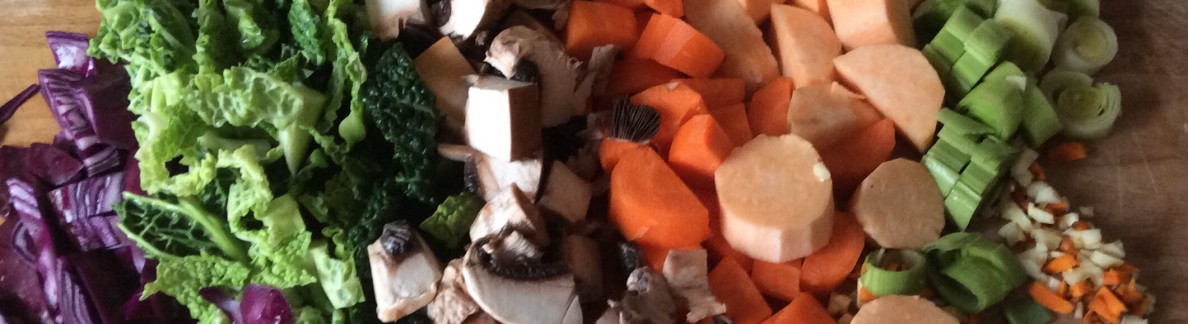
 I just learned today that it is Invisible Disabilities Week. As someone who has spent her whole adult life with an invisible disability, I thought I would share this ‘short’ anecdote on what it is like to look strong and healthy but struggle with a pain and disability that is not obvious to the casual observer. I know I promised short, but this wasn’t planned and you know me, this could go on a bit, for which I apologise in advance – but there are some nice photos too (and yes, that is a packet of crisps in front of me!)
Many moons ago, in a county far, far away, I had a prolapsed disc that refused to heal. I was in my early twenties with a toddler son, had spent a couple of months in bed on the advice of my doctor but could not get moving. I did, however, read the complete Thomas Hardy oeuvre and while doing so, discovered my son was teaching himself to read when he looked at a paragraph containing lots of t’s, p’s and s’s and announced, ‘Look, Mummy, that’s like Top of the Pops!’ (A popular BBC chart programme).
I had three weeks in hospital on traction where even hospital staff would leave my meals by the side of my bed while I lay flat on my back unable to reach, because I was young and they were preoccupied with the older patients. Eventually, I was sent home with a steel reinforced surgical corset and instructions not to spend a lot of time sitting. A few weeks later, I had my check-up appointment at the hospital. There had been no improvement. Despite the ‘no sitting’ command, I was kept waiting – and sitting – for two hours for a five minute chat that ended with ‘come back in a few weeks’.
Afterwards, I had to wait in reception for a sitting ambulance to take me home. Unfortunately, it was almost lunchtime but there was one ambulance leaving before the lunch-break and I inwardly heaved a sigh of relief. I was in excruciating pain, all the while knowing that things were going to get worse not better for my trip to the doctor (a constant theme in my life) and all this sitting was doing me more harm than good.
A driver came over. He had one seat left. He looked at the elderly lady next to me with a stick. She had told me she had been to the audio clinic to have her hearing checked. He looked at me. Young, smiling, long shiny hair. He chose the elderly lady.
I wanted to cry. I didn’t know how I was going to get through the next hour, possibly longer, before another ambulance left. Not only was I in pain, but despite the corset, I didn’t have enough strength to sit upright, I kept tilting.
I eventually made it home about 3 p.m., having left home at 8.30 a.m. Up until that point, I hadn’t sat for more than half an hour at a time in several months. The pain was so severe I almost passed out before I could get upstairs to bed. My poor excited son had to make do with the briefest of hugs before the painkillers took hold and knocked me out.
That was a long time ago. During the interim decades, things have improved and got worse and improved in a monotonous recycled pattern including surgery, torturous treatments and therapies, car accidents and so on. My overall health is much improved since I changed my diet and lifestyle, gave up prescription drugs that never helped and always made things worse, and took my health into my own hands. However, despite seasonal improvements during warm weather, I have never regained my strength and full mobility.
 And yet… just yesterday, my elderly mum was lauding my efforts to look after her during her stay at the weekend, saying ‘It’s lovely to have my daughter back, back to normal!’ A smile and a talent for acting work wonders in reassuring others, but they also help make a disability invisible and raise expectations.
 On Saturday, we took Mum out to see the barges on the canal. She had a lovely time, sitting in the sun eating ice-cream – where unexpectedly, an owl and a hawk where among the patrons! – happy that the three of us were able to have a rare outing together. I usually stay at home.

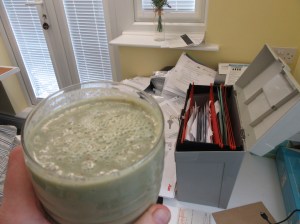 She went home next morning and I spent the rest of the day sorting out all her files (with the help of a green smoothie of course).
This morning, I couldn’t get out of bed. My whole body felt like I had been kicked by a mule, my back was on fire, I had no strength, I was exhausted despite twelve hours in bed. I couldn’t get dressed. When I did get up, about 11.30 a.m., I sat with a heated pad on my back while my husband brought me herbal anti-inflammatory drops and an anti-inflammatory ginger and turmeric juice.
Two hours later, I am dressed and writing this post. I will soon be making phonecalls on my mother’s behalf. I will call her to see if she is ok after the journey home. I won’t of course tell her how I’m feeling.
As someone recently said to me, we have no idea what is going on in other people’s lives. If someone is rude, irritable, in a bad mood, unwilling to contribute help to some event you’re organising or collect your kids from school etc. please bear in mind they may be suffering a devastating migraine attack or a flare-up of rheumatoid arthritis; they may have an undiagnosed brain tumour, they may have insufferable chronic pain, MS, ME, or any number of invisible conditions. If they are behaving ‘inappropriately’, they may have Asperger’s, anxiety, dementia, having a panic attack, depression or on the verge of going into a diabetic coma.
And most of all, just because someone with a disability or chronic illness can do something one day, doesn’t mean at all that they can do it repeatedly, or even ever again. My mum thinks that everything I do when she is here is what I do every day. She has no appreciation of the superhuman effort I make when she – or anyone else – is here, to make her stay comfortable, to give her something to tell her friends about, some nice memories. But once she has left, I am back in bed, desperate for rest and relief.
Please note: This was written on the spur of the moment as a plea on behalf of others, not for sympathy. I am used to the ups and downs of my life and make the most of it. I am a positive person who laughs a lot and I enjoy seeing Mum doing things she wouldn’t otherwise get to do and I know it means a lot to her that I join in.
Ps It did get a bit long, didn’t it? Oops…
Feeling Overwhelmed: World Mental Health Day
Monday Meditation: Osteopathy, Rest & Recuperation in Nature
Laughter Really Is The Best Medicine – Paint a Rock & Give a Smile to Someone Who Needs It!
The Mood Booster: Raw Chocolate Mulberry, Banana & Walnut Smoothie
Copyright: Chris McGowan
 pearsnotparsnipsdotcom
Such an important reminder about invisible suffering, Chris. It’s so easy to take health and easy mobility for granted when we have it.
I empathize with the challenge of your back pain. I injured my back this summer – twice. The first time in a new place, my lower back, lifting heavy landscaping blocks. It was hard for me to walk for a couple weeks, but the pain gradually eased. I decided I could at least cut some of my overgrown lawn with a light weed-trimmer and injured my upper back, aggravating on old injury that strikes periodically with a vengeance. The unrelenting muscle spasms are unbearable and totally debilitating when provoked. Luckily I found a physical therapist this time who was able to help. In the meantime, I tried to prepare for the class I would be teaching in the fall (and am now teaching). Despite the pain, I had to write and post class assignments and materials online to meet deadlines. Now that the pain is mostly gone, I can see all the typos and mistakes in those assignments and it’s quite embarrassing. My students will never know how hard it was to get them done in time!
Sending you gentle hugs and my best wishes. ❤
LikeLiked by 2 people
Ouch, I feel for you. I too have had to write assignments while barely able to sit amd my daughter had to actually do her University Finals while standing at a lectern as her back had given up and she couldn’t sit. When something goes wrong with your back it affects everything. I still can’t hold a telephone to my ear or hold a book or even a newspaper to read. Thank you for your gentle hugs, always appreciated 💜
LikeLiked by 2 people
I understand that you were disclosing to increase empathy vs. asking for sympathy – but you have both from me. There are SO many “invisible disabilities” – both mental and physical – that deserve compassionate understanding and better treatment, though they receive it rarely.
This is an important post — one that makes me wonder if we would actually be doing the world a HUGE favor if more of us would disclose our struggles to the people in our lives (especially when we are expected to do something that those lucky enough to be strong and healthy find a piece of cake, whenever we must decline participation). I’m not convinced that soldiering on silently or limiting our disclosures to blogs and articles serves us OR the world we share.
It is definitely past time to write letters of protest to thoughtless hospitals and complain TO and ABOUT thoughtless health-related personnel as well. It’s shameful, actually, that institutions and professions dedicated to healing don’t walk their talk.
Little will change unless we are willing to overcome our reticence to insist that it does. That’s what these Awareness Events are all about – and why I went back to link this article to my October Awareness Calendar (where it will remain each year as long as the link works and I am still dedicating time to blogging).
I want to encourage anyone reluctant to “concern” others to remember that another term for concern is consideration!
It’s tough for those who care about us to be considerate about something they don’t KNOW about – and “invisible” disabilities top the list of those items, don’t they?
xx,
mgh
(Madelyn Griffith-Haynie – ADDandSoMuchMORE dot com)
ADD/EFD Coach Training Field founder; ADD Coaching co-founder
“It takes a village to transform a world!
LikeLiked by 3 people
xoxoxo take care!
LikeLiked by 1 person
Thank you 😊
LikeLiked by 1 person