Sprouting for Health, Energy and the Environment!

Recently I published a recipe for Warming Stir-Fry with Avocado, Alfalfa and Sprouted Beans and was asked where to obtain the beansprouts. Well, the answer is, your kitchen counter!

It so easy to grow your own, takes no time or effort and they provide protein and oodles of more useable nutrients than cooked foods. Enzymes, vitamins, minerals, fibre and essential fatty acids (that burn fat and are usually in short supply in most diets) increase dramatically during the soaking and sprouting process and are more easily absorbed by the body.

Not only are homegrown sprouts good for body and soul (growing your own is a satisfying and life-affirming activity), but they are also good for the environment. Buy organic, untreated seeds, nuts, beans or legumes and you omit nasties: pesticides, additives and other unwanted chemicals. Ready grown sprouts are often treated with chemicals before packaging. (NB You need to buy seeds from a health food shop/supermarket or online eg Amazon etc NOT a gardening shop!)

They are inexpensive, 1 tablespoon of seeds produces several days’ worth of sprouts – depending on how often and how many people eat them! You can rotate the varieties and have your own little sprout garden in your kitchen, producing nutrient-dense plants for your salads, sandwiches and lunch-boxes and the children will enjoy the process of soaking, watering and watching them grow as well as benefiting from the foods themselves.

So, what do you need and how do you do it?

There are 3 methods: the third actually produces microgreens, a stage further on than sprouting and involves soaking seeds and sprinkling them on a tray of organic soil, watering and letting them grow. But we want to produce sprouts, so you need either a sprouting tower like this one:

This thirty-year-old tower has 3 sprouting trays, a lid that is ventilated to allow air to circulate and a bottom tray where the water drains off – if buying new, check it is BPA-free

or large, wide-mouth mason jars with either sprouting lids (available from healthfood stores or online), cheesecloth or muslin and a rubber band to keep it in place.

You can sprout most seeds, nuts, beans or legumes – except kidney beans, they are poisonous if eaten raw.

For either method, the first thing you need to do is wash your hands – hygiene is important, then rinse the seeds and pick out any grit or discoloured or broken ones and soak them overnight in pure water. For 3 trays, you could use 1-2 teaspoons of alfalfa or broccoli seeds between 2 of them and 1-2 tablespoons of mung beans in the third. Use 3 times as much water as seeds. (Broccoli seeds provide many times more nutrients than normal broccoli).

image

(If using jars, you can put them straight into the containers). Next morning, drain them into the trays and rinse again (one type of seed per tray, they all grow at different rates).

Rinse and drain twice a day, pouring away the excess water.

image

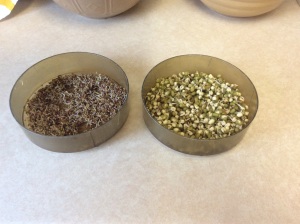
After Day 1, the mung beans have swollen and are beginning to sprout.

For the jars, cover and stand upside down, if possible at a slight angle, and rinse at least twice a day.

The sprouts will grow faster in warmer weather and in exceptionally hot weather may need an extra rinse. Don’t let them dry out but don’t overwater! Be sure to drain off the excess to prevent mould and bacteria developing.

image

After 2 days, they are well on their way. These were growing during a very cold February.
image

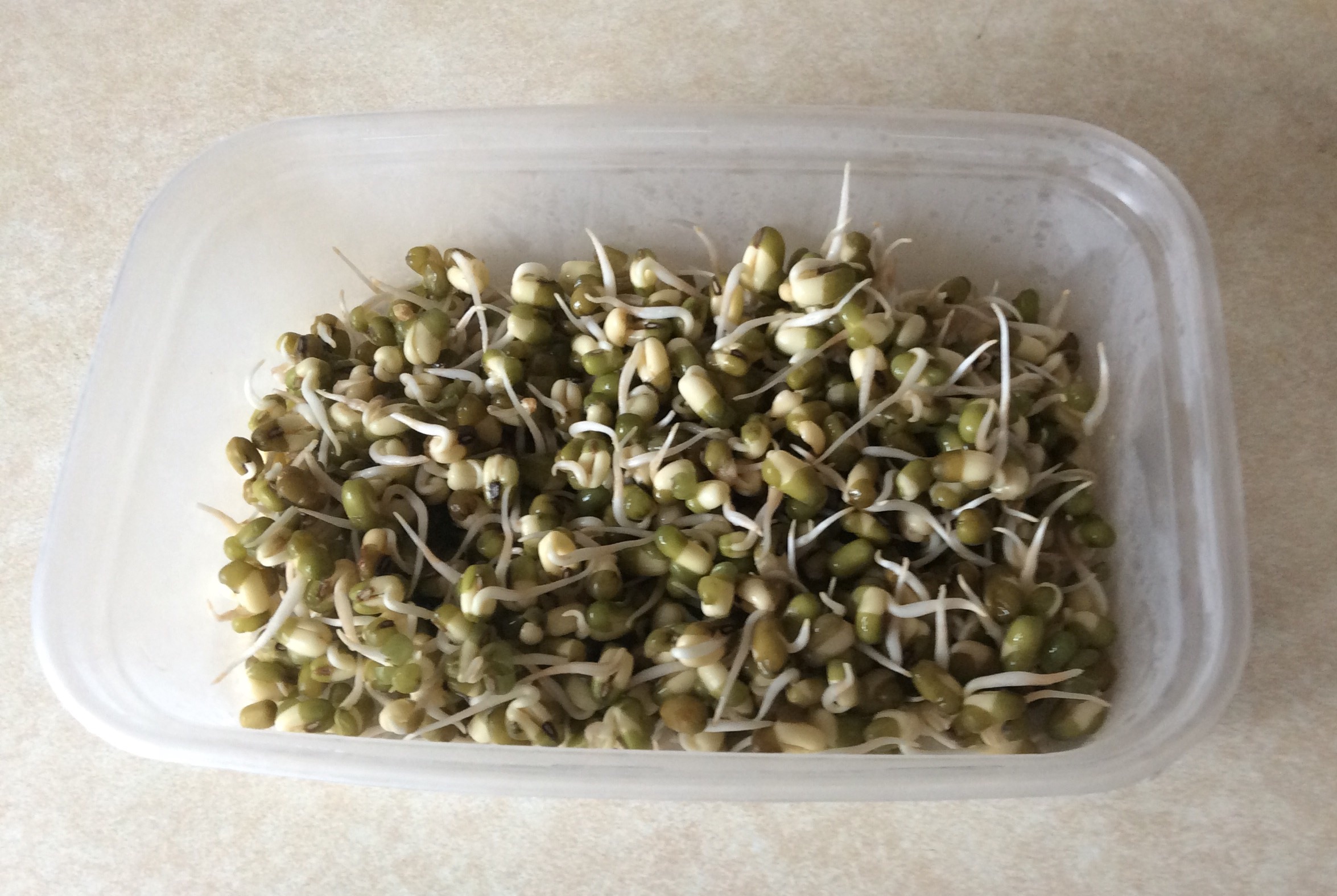
3 days and the mung beans are about an inch long and ready to use! The alfalfa needs another couple of days.

image

When you harvest the mung beans, rinse and either store them as they are, covered in the fridge – they will last up to a week or more – or place in a bowl of water, swish them around and the green hulls will float off and can be removed if desired. Some people think they are a little bitter, but of course you will be discarding nutrients too.

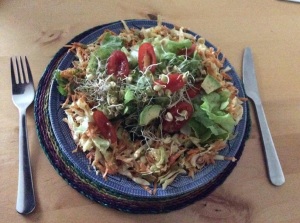
The sprouts can be used in salads, sandwiches, with stir-fries or as garnish for warm soups (the less heat the more nutrients you retain).
image

Sprouted seeds, beans, nuts and legumes are highly nutritious and are particularly rich in Vitamins A, B Complex, C and E, but alflafa is also a good source of Calcium, and a very good source of Vitamin K, Folate, Iron, Magnesium, Phosphorus, Zinc, Copper and Manganese.

image

28596240_Unknown

Broccoli Sprouts

You can have a lot of fun with the kids using alfalfa sprouts:

image

There have been comments in the media about the dangers of ecoli in beansprouts. Firstly, I would say commercial enterprises don’t much like us growing our own rather than buying their nutrient-poor, mass-produced products and secondly, providing you keep up your hygiene standards: wash your hands, drain off the soaking water and scrub out the trays/jars, then all should be fine.

We have been growing sprouts for 30 years and neither my family nor friends have had one problem with ecoli.

I hope this helps inspire you to start producing your first beansprouts.

Copyright: Chris McGowan

Warming Stir-Fry with Avocado, Alfalfa & Sprouted Beans

image

This is one of those meals where it was a case of just tossing together whatever was available with no thoughts of creating a new recipe for the blog, but it turned out so well I decided to post it anyway. It looks a bit like a bird’s nest, but satisfying and tasty.

These are our favourite kinds of meals: easy, quick, one chopping board, a sharp knife, spatula and frying pan. Little mess and lots of nutrients.

Prepare all your ingredients beforehand, have your seasonings ready and plate warming, because it all comes together very quickly.

This recipe is for 1 serving, amounts and timings are approximate.

Ingredients are organic where possible. For a little more colour you could add spiralised or shaved carrot. I am sensitive to nightshade foods, so I haven’t included bell peppers.

Ingredients

1 Tsp Raw Virgin Coconut Oil

1 Small Onion, sliced or several Spring Onions, chopped

2 Cloves Garlic, minced

2 Thin Slices of Fresh Ginger, minced or chopped very finely

6 Sugar Snap Peas, topped, tailed and chopped

Half a Stick of Celery

4 Large Chinese Leaves, including stalks, chopped

1/4 Large Courgette, spiralised

Handful of Cashew Pieces

Half an Avocado, chopped

Handful Green Lentil Sprouts (or any other sprouted beans)

Handful Alflalfa Sprouts

Few splashes of Tamari

Freshly Ground Black Pepper

(I haven’t included salt as the Tamari is quite salty anyway)

Method

Melt Coconut oil in Large Frying Pan until a piece of onion starts sizzling, but not smoking

Add onion, garlic and ginger and stir-fry for a couple of minutes

Add Celery and Sugar Snap Peas, keep stir-frying for a further couple of minutes until the onion starts becoming translucent but not soft or brown

Add Cashew pieces and Chinese Leaves and stir-fry until leaves start to wilt a little

Add Spiralised Courgette, plenty of Black Pepper and a few splashes of Tamari

Keep stir-frying all the time

When everything is cooked but still has a bite to it, remove from heat, add Lentil Sprouts, stir a few times, add Avocado , a bit more Tamari and Black Pepper if desired and remove to hot plate. Add Alflalfa Sprouts.

Leave washing up, sit down and eat straightaway!

Copyright: Chris McGowan

Spiralising: A Great Way to Get Your Kids to Eat Their Greens, Reds, Yellows …

I have a confession to make. You know all those kitchen gadgets I mentioned in Gadgets Anonymous ? Well… <typing in quiet voice, head down, eyes looking sheepish> I have another one… But it’s not a blender!

Nope, a spiraliser. Lurch is its name.

To be fair, it isn’t new. It’s been sitting in the cupboard for some time, still in its box, waiting for us to catch up to it. And last night, we finally did, amd what fun!

image

On this plate are a Red Apple, a Carrot, half a medium Courgette and a quarter of a long Cucumber. Look at the wonderful colours!

It is highly unlikely anyone would sit and eat those items whole with a knife and fork. But spiralised, it becomes a whole different experience. Spiralising really does make a difference to how they taste, the texture and how much you can eat.

I had all this for dinner last night, along with a couple of very tasty, easy-to-make items from Jason Vale’s Super Fast Food app, which I hope to review when we’ve given it a good workout – so far, so thumbs up!

(We made the Zesty Creamy Rocket Pesto and the Nutty Seeded Crackers, both flavourful and nourishing and now added to our menu for regular use).

image

For the kids, it’s so much fun watching the twirly ribbons of veggie noodles emerging from the spiraliser, they just want to take a handful, tip their head back and start feeding the spirals into their mouth.

The Lurch spiraliser is very light and easy to use. Kids can help make their noodles with supervision. It comes with 3 different blades which are stored in the side and have protective hand grips to make it easy to switch.

image

It has suction feet to stop it slipping or travelling while in use. It also cores, and kids find the leftover middles amusing to play with or eat, or they can be juiced.

I am so excited! I know I am late to the party as far as spiralising is concerned, but I’ve been wanting to try for so long and better late than never!

Just hope the juicers and blenders aren’t going to view this as an act of betrayal! (But they needn’t worry, they continue to have pride of place on the kitchen counter, the spiraliser for the moment is still confined to the cupboard).

With grateful thanks to K and M! x

Copyright: Chris McGowan

Super Juicing: I Feel Good! Now What? 11 Tips on How To Maintain Your Juicy Success

As the irrespressible James Brown sang, ‘I Feel Good, I Knew That I would!’ (Click the link to see black & white footage of a very energetic performance and you’ll see what I mean).

So, here we are, the end of my Super Juice Challenge following Jason Vale’s SuperJuiceMe! Plan.

Results

I feel alert, energised, my digestion is calmed, I am calm, my aches and pains are calmed, no inclination to snack mindlessly, and I have lost 5lbs – but that was just an added bonus, I was not looking to lose weight. 

Plus, despite having to cope with some quite stressful situations, I am the only one in the family not to have caught a cold or cough this month!

There were times when I really wanted to crunch an apple and occasionally I added some ground seeds to a juice, but the Plan allows for occasional SOS additions. Apart from my Bit of a Wobble, I found it easy to get into the routine of it and didn’t have any desire for junk, sweet or savoury treats.

The plan is devised so that every so often you have a sweet, fruity, almond milk smoothie that assuages any craving for something sweet or just different from a juice, and the juices provide all the essential nutrients your body needs.

So no cravings.

Many people ask, so what now?

  1. Well, the first thing is to say what you don’t do: Don’t start planning your next visit to a fast food restaurant! Not that you will want to after any kind or length of juice cleanse. You will find that your tastebuds have been rewired. What you really look forward to is a colourful, crunchy salad or a big, juicy green apple!
  2. Likewise, don’t be persuaded by those around you to go out for a celebratory meal/drink – you will regret it. Your body has just been given a oil change and tune-up and you don’t want to start putting the wrong fuel in!
  3. It is important to ease yourself in gently to eating solid food or your digestion will suffer and you will lose some of the benefits you’ve striven to gain.
  4. Continue having a couple or more juices a day for the first 2 or 3 days at least – I do this normally when I am not juice cleansing anyway – no coffee, alcohol, grains, pasta, meat, dairy.
  5. Eat slowly and mindfully, chew thoroughly, sitting down at the table.
  6. Try to keep eating fresh and raw as much as possible, as many colours as possible on your plate.

image

My First Post-Juicing Meal on a Plate: Mixed Rocket & Spinach Salad Leaves, Sugar Snap Peas, Mung Bean Sprouts, Carrot, Grapes, Broccoli, Cucumber with Tamari and Olive Oil Dressing

7. If you eat fish, you can then introduce fresh salmon (high in omega oils) or steamed or baked other fish. Light Soups or Baked Sweet Potatoes. Steamed Veg. Stir-Fries

8. Keep grains to every other day to begin with to allow your digestion to get back into the swing of things and to help identify any problem foods.

9. Take note of anything that makes you feel yuck. Anything that makes you feel tired, uncomfortable, bloated, have heartburn or indigestion and cut it out for a while. Try again another time and if the same thing happens, probably avoid.

10. There are several follow-on plans you can use if you need ideas and support: Jason Vale has his 5:2 plan, the Soup’n’Juice Plan and his new Super Fast Food App that has over 100 recipes and the facility to devise your own 7 Day Meal Plan with shopping list provided. See his website for details.*

11. Above all, Keep Juicing!

http://www.juicemaster.com

NB If you are thinking of doing a Juice Plan, please see your doctor first.

Copyright: Chris McGowan
Super Juicing Day 6: The Tempting Smells of Melted Cheese and Spicy Teacakes

I am not going to lie to you, doing a long juice fast or cleanse is not easy. It requires mental and physical preparation, commitment, determination and sheer will-power. You also need to be able to explain your actions to the naysayers!

By now, after doing several juice fasts, I have all this down-pat. But yesterday I struggled.

For me, the hardest part is the smells of family cooking. Not the actual food. I wouldn’t normally eat the pies, pizzas, potatoes or pasta anyway.

No, it’s just the smell.

Before I gave up dairy, my favourite food was cheese. I love/d cheese and never for a second did I believe I could ever go a day without it. It would be my luxury item on Desert Island Discs!*

When I was a student, I was in cheese heaven. The local market would sell huge rounds of Lancashire cheese, both crumbly or creamy, take your pick or have both, why not?! I would buy a wedge to take home but would have consumed it all on the way back. Too irresistible.

When I met my husband, he would only ever eat cheese sliced with fruit cake once a year at Christmas! It’s a Yorkshire thing. Now, he eats it practically every day.

But it’s not the fact of cheese being around, it doesn’t bother me. I really have no desire to eat it.

It’s the smell of cheese melted that is the thing that is causing me the most problems on this juice fast. Melted cheese. It’s there, every day. On pizza, on pasta, on rice, on jacket potato and, his pride and joy, home-made cheese and herb sausages!

Don’t get me wrong, I definitely don’t want to eat the cheese.

There’s just something primal about certain food smells that are tied up with memories. They conjure up the pleasures, the joy, the social rituals, family get-togethers.

The saliva glands start to work overtime and the digestive juices begin to gurgle. Your tummy rumbles. I practically drool, the juices are flowing so freely.

Until you do a juice fast,  you aren’t really aware of how much of your day is spent thinking about, preparing, cooking and eating food. My juices are made in the morning, and take very little time to consume, so that leaves a huge chunk of empty hours where you find yourself looking around for something to occupy your thoughts and distract you from the smells while others are cooking and eating.

My husband, though, doesn’t get this.

Every mealtime we have to go through the same ritual when he asks me what he should have for lunch/dinner etc.

Should he have quiche? Pizza? Pasta?

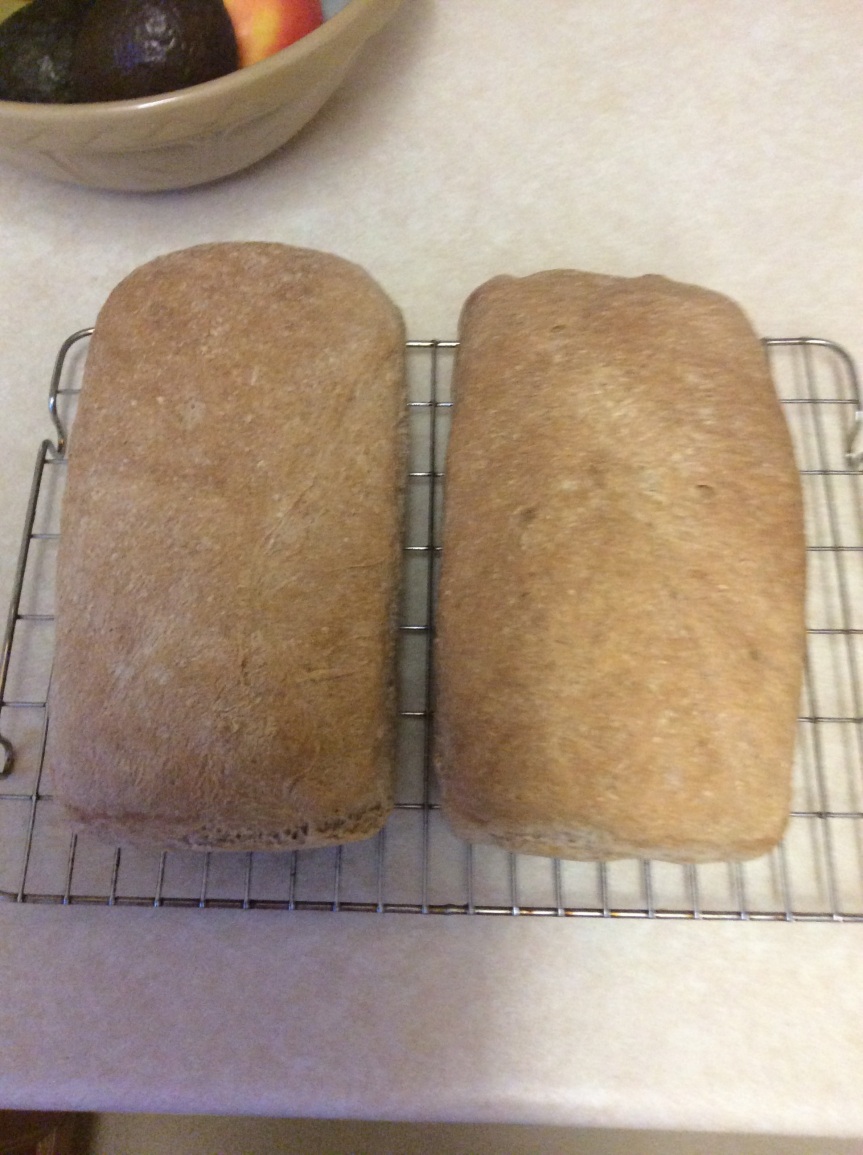
Then, this morning I woke up to the smell of freshly baked bread!

image

(And don’t get me started on his toasted cinnamon fruit teacakes!)

Oh, the smells, the smells!!

*http://www.bbc.co.uk/programmes/b04stgz0

Copyright: Chris McGowan

Cumin and Have Some Soup!

A spicy, satisfying and nourishing soup to warm your cockles – and everywhere else!

This is my favourite when it’s cold and dark and I’m hungry but don’t know what to have and there isn’t much in the fridge anyway – you know, that day before shopping day?

Serves 2

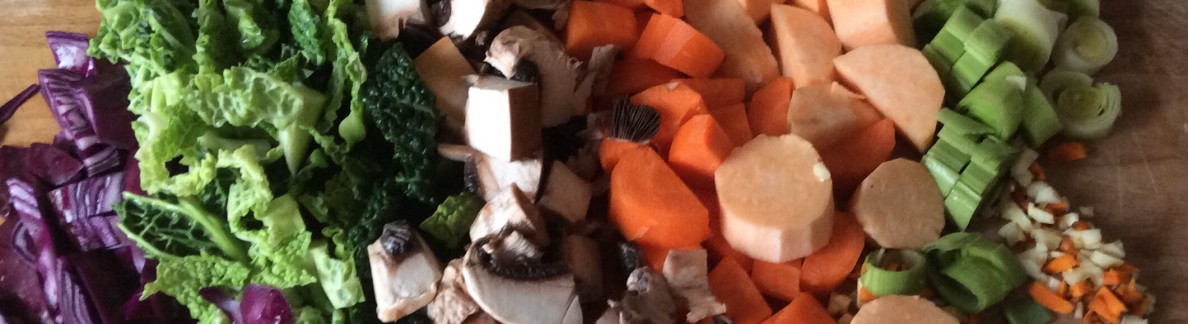
image

It takes about an hour from start to finish.

Ingredients

(All veg, oil and spices are organic, so the peel is left on the carrots and sweet potatoes, if not scrub and peel. All measurements approximate.)

1 Tsp Raw Virgin Coconut Oil

1 Tsp Cumin Seeds

1 Large Onion, sliced thinly

1 Large or 2-3 Small Cloves Garlic, crushed

2 Medium to Large Carrots, scrubbed and sliced

2 Medium to Large Sweet Potatoes, scrubbed and sliced

Half Stick of Celery, scrubbed and sliced

1/3 Cup Orange Lentils, rinsed

1 Vegetable Stock Cube dissolved in approx 600 mls boiling water

Freshly Ground Black Pepper

Couple of Splashes Tamari (dark gluten-free soy sauce, a staple in our kitchen)

Fresh Coriander to serve – optional

Method

Melt the oil

Gently toast Cumin Seeds, stirring around so they don’t burn

Ditto Garlic and Onions

Add rest of Vegetables, stir a few times, then add some black pepper

Cover and allow to sweat gently for about 15 mins. stirring once.

Add Lentils, Stock Cube & Water, Tamari.

(Be sure to have enough stock to easily cover the veg as the lentils will soak up some of it)

DON’T BOIL

Simmer very gently on a low heat for about 30 mins. until lentils cooked and vegetables are soft.

image

Blend as little or as much as you like – We use a stick blender as we like to leave some whole, but the liquid quite thick

Taste and add more pepper if desired.

You’ll notice there is No Salt on the list. This is because the Stock Cube and Tamari already have it in and the soup can be a little salty if you put extra in. Add it at the table once you’ve tasted if need be. (Pink Himalayan is best as it still contains all the minerals and has no added nasties).

Add Fresh Coriander to serve.

Copyright: Chris McGowan

Lemony Tiger Nut Truffles

Tiger nuts aren’t just tiny little balls of protein, they are also versatile in flour and milled form.* I decided to add some milled to these lemony truffles.

(While devising this recipe I found myself humming Mud’s Tiger Feet and discovered this youtube video of Mud live on ToTP 1974. It’s hilarious and can’t fail to make you smile! http://youtu.be/QZvPtzFyrSM)

image

Continue reading “Lemony Tiger Nut Truffles”

Smooth and Creamy Hemp Milk

image

I gave up dairy many years ago and relied on rice milk instead. But recently I discovered homemade nut milks and have become a true convert. Much creamier, tastier and more nourishing than the rice version. Lately, though, I tried homemade hemp seed milk for the first time and thought I would share the recipe.

You can use the milk in SMOOTHies, on cereal or to make Spicy Raw Hot Chocolate or try a SMOOTH Cool Chocolate Hemp Milk: just whisk up some hemp milk with some Raw Cacao Powder and Lucuma Powder or Coconut Palm Sugar to taste and plonk in some ice cubes.

There can only be one choice for our music today, let’s get SMOOTH with Santana – see what I did there? – (youtube link here: http://youtu.be/B0WlQsotC1Y (*WARNING* brief flashing lights at beginning) and start blending:

Ingredients
1 Cup Raw Chocolate Company Shelled Hemp Seeds* (no need to soak)
3 Cups Filtered Water
3 Pitted Medjool Dates, depending how sweet you want it
1Tsp Vanilla Extract
Pinch of Pink Himalayan Salt
Optional: 1Tbsp Organic Soya Lecithin or
1 Tsp Coconut Oil to make it creamier

Method
Blend for about a minute until smooth.

Some people like to use it as it is for a fuller flavour and of course you get all the nutrients, but you can also strain it through a nut milk bag . You can always dry the pulp and use it in burgers, cakes or smoothies.
This recipe makes about 1/2 to 3/4 of a litre 
It will keep chilled in a sealed container for about 2 or 3 days.

Hemp seeds are a good source of protein, B vitamins, Vitamin E, minerals and omega oils.

*http://www.therawchocolatecompany.com/

Copyright: Chris McGowan

Gorgeous Goji Berry Smoothie

image

This protein-packed smoothie features Organic Raw Goji Berry Powder, Organic Shelled Raw Hemp Seeds and Organic Raw Goji Berries (we use The Raw Chocolate Company products*). It can be made in a small blender, we used the kind that can also be used as a flask, so you blend and go.

 All measurements are approximate.
I am a great believer in adaptation and substitution, so don’t panic if you don’t have everything on the list. You are advised, however, not to take this too literally as one family member did when missing out the peas from the raw Pea and Mint Soup and the lentils from the Lentil Stew! Continue reading “Gorgeous Goji Berry Smoothie”

Raw Energy

 image

Over 30 years ago Leslie and her daughter Susannah were telling us that frying oil turns it toxic, that vitamins and enzymes are destroyed in the cooking process, about sprouting and juicing to protect against cancer and how raw foods balance blood sugar and hormones. These were crank concepts to most people, now they are widely accepted. 

They promised that changing to a mainly raw plant-based diet would lead to a new level of health and vitality, that you would stay young longer and lose weight. It would also help prevent degenerative diseases and allergies as well as helping alleviate chronic illnesses.

And you know what? They were right!

I asked for a food processor for my birthday – it is still in service over 30 years later – I ate raw and was the healthiest I had ever been. I had a chronic condition and was in a lot of pain, but eating mostly raw and no junk made me feel more alive, have more energy and lose weight. My pain was reduced and my mobility increased. A new friend, coincidentally, had also discovered the Kentons and we had fun trying out the recipes together, our families being a bit sceptical to put it mildly!

I love their raw treats, in fact those pages are so well used they are covered in food stains and annotations as I have added to and adapted the recipes. A few years ago I lent the recipe book to someone who didn’t return it, I can’t even remember who it was. I have been missing it but I recently found a secondhand copy on Amazon and am so pleased to have it again.

image

Carob Fudge, one of my favourites

Eating raw doesn’t mean you never have anything cooked or warm – I couldn’t make it through a winter without soup or casserole – rather, you aim for about 75-80% raw food diet.

And raw doesn’t always literally mean raw: officially, raw means any food that hasn’t been heated above 48C. But even just eating raw some of the time, adding more fruits, vegetables, legumes, nuts and seeds to your diet, whole or in the form of juices and snoothies, will make a huge difference to how you feel.

I have been sprouting beans and seeds ever since, in fact I just sprouted some mung beans and alfalfa. They are so easy to do and so packed with nutrients.

image

Homegrown alfalfa sprouts

image

Homegrown mung bean sprouts

I also like to grow lentil, chickpea and broccoli sprouts.

I hope this snapshot of raw eating inspires you to make some changes so you can benefit from more energy, feel more alert and perhaps even alleviate those niggling aches and pains. It works for me!

Leslie Kenton’s website is a mine of information on all things to do with health, beauty and spirituality.

http://www.lesliekenton.com

*LESLIE KENTON’S BIOGRAPHY (found on Google)

A former consultant to European Parliament for the Green Party and course developer for Britain’s Open University, Leslie is trained in Chinese Medicine, nutrition, homeopathy and bioenergetics. She was the first Chairperson of the Natural Medicine Society in the UK. Her contribution to natural health was honored by her having been called on to deliver the McCarrison Lecture at the Royal Society of Medicine in London. She also conceived and created the worldwide Origins range for cosmetic giant Estée Lauder.

LESLIE KENTON’S TELEVISION PROGRAMS
Her network television programs include Raw Energy, a cookery series, and Ageless Aging, both of which she conceived, wrote and presented herself. She has made several short films on health and spiritual topics for the BBC. Her TV documentary To Age or Not To Age, screened in the Southern Hemisphere, made television history when, in only 5 weeks, the diet and exercise protocol she designed reversed parameters of aging in people between 30 and 60, in medically measurable ways.

Copyright: Chris McGowan